I placed the flowers in Robbie’s memory on the sand, arranging them slowly, as if touch still mattered. The tide crept in, cool around my ankles, withdrawing and returning with a rhythm that felt almost deliberate. This was a special place—not because it was beautiful, but because it had once borne the weight of our closeness, and even now seemed to breathe with it.
Charlie didn’t go to Paris for Christmas. A family dispute—best addressed through absence—kept him away. Instead, he stayed with a cousin in Woodstock, near Blenheim Palace: an improbable place for pleasure. I was content with the opposite arrangement. Christmas alone. Eating, drinking, letting Netflix decide what mattered.
On Christmas Eve, I dreamed he climbed into bed and lay on top of me. His naked body was warm, yielding, unmistakably real. He kissed me. A faint musk rose from his skin—intimate, animal—stirring every sense at once. At last, I thought, this is the closeness.
I woke up with the sensation intact. The dream clung to me through Christmas morning, vivid enough to unsettle. I searched for an explanation and learned that smell can infiltrate dreams, especially when memory and desire are involved. Olfactory dreaming, they called it. Cologne was the usual example.
In the nineteenth century, a French physician, Alfred Maury, described inducing such dreams by getting his assistant to place eau de Cologne beneath his nose while he slept. On waking, Maury claimed to have dreamt of Cairo, of the perfumer Farina’s workshop, of adventures set loose by scent alone.
I hadn’t smelt Cologne. What lingered with me was the smell of a boy. And with it, a quieter truth: Charlie and I had never moved beyond kissing.
Someone, inevitably, had to puncture the theory. A psychiatrist dismissed the idea entirely. You don’t smell the coffee and wake up, she insisted. You wake up, then you smell the coffee.
I abandoned science and let Spotify take over. It suggested an album by Wolfgang Tillmans, which surprised me. I’d known him only as a photographer. The music turned out to be a sound work made for an exhibition—joy and heartbreak threading through collapse and repair.
I first encountered Tillmans years earlier through a Pet Shop Boys video composed almost entirely of mice living on the London Underground. Ever since, I’d found myself scanning platforms, tunnels, tracks—without success. A memory surfaced: my friend Stephen once worked on a four-hour Tillmans sound installation of It’s a Sin. He now despises the song completely.
Christmas dinner was an indulgence of sorts: cold baked beans eaten straight from the tin. I spent an hour scrolling through films before accepting, once again, that choosing outlasts watching. I downloaded the Christopher Isherwood biography David had recommended—the one that never seems to end—and fell asleep within pages.
When I woke, the room had darkened. Charlie had messaged: Will be home tonight at about eight x.
Transport on Christmas Day was nonexistent, yet somehow he’d convinced his cousin to drive him 130 miles. When Charlie arrived, I asked where his cousin was.
“Gone back,” he said.
“You didn’t invite him in?”
“It’s Christmas. He’ll want to be home.”
“And petrol money?”
He hesitated. “I didn’t think of that.”
Our former lodger once called Charlie a “me, me, me person.” Another friend was less generous and called him an asshole. Perhaps it was cultural. Perhaps it was simply him. Charlie struggled to imagine himself from the outside. I told myself it wasn’t malice. Just a narrow field of vision.
Despite the journey, he looked fresh, handsome. He smiled; I mirrored it. I considered mentioning the dream, then decided against it.
“Why come back early?”
“I shouldn’t have left you alone,” he said, without pause. “It’s Christmas.”
While he dropped his bag in the bedroom, I switched on the tree lights. We exchanged gifts a day early.
His were faultlessly chosen: Salò on Blu-ray, Sargent, Ramón Novarro, Edmund White, a glossy Igor Mattio photography book. Then he disappeared into the studio and returned with a canvas. He turned it around.
It was me.
He’d painted me sitting, relaxed, looking beyond the frame—as if caught somewhere warmer, lighter. My eyes were generous. My mouth was kind. Around my neck he’d included a thin silver chain, a birthday gift I wore only on rare occasions. The detail felt deliberate, almost intimate.
“I painted while you were writing,” he said. “I hope you like it.”
I had never been seen like that before. Not by anyone. I felt exposed, and cherished.
“I don’t know what to say,” I told him.
“One day,” he said lightly, “when you’re old—célèbre—people will say, painted by his French lover.’”
Charlie went to shower. Alone, I recognised a flicker of shame. I’d suspected his absence was a ruse. I’d rehearsed disappointment, punished him silently for not being who I wanted. The dream—so tender, so convincing—had fed that instinct. Sex can exist without love; love can exist without sex. The phrase circled uselessly.
Still, it would be nice.
There it was again. That reflex. The mind’s preference for negativity over positivity.
Charlie returned wearing only grey jogging bottoms and a Santa hat. He stretched out beside me on the sofa, smelling faintly of crushed mandarins, and rested his head in my lap.
“A Christmas film,” he murmured. “Something cosy.”
I stroked his stomach as we watched The Holdovers: a misaligned teacher, a sharp-tongued cook, a boy full of grievance. By the end credits, Charlie was asleep.
I didn’t move. I was afraid that motion would undo everything. His weight, his warmth, the faint citrus on his skin—it felt provisional, like something borrowed. The room held its breath.
I loved him then with a sudden, almost painful tenderness. Not the urge to claim, but to preserve. To keep the moment intact, untouched by language or expectation.
Don Bachardy and Christopher Isherwood. Early 1950s. Photograph by Zeitgeist Films / Everett Collection.
My friend David is reading a biography of the writer Christopher Isherwood on his Kindle. It has taken him a long time to get through—not because the book is difficult, but because it is extremely long. He joked that his Kindle had travelled with him from London to Munich and Paris, and back again, and he had only reached the fifty-percent mark.
“That’s the problem with an e-book,” he said. “We don’t talk about pages anymore. We obsess over percentages.”
I suggested that perhaps he was in too much of a hurry to finish it.
“That’s true,” he reflected, “but don’t you always have one eye on what you’re going to read next?”
David is a lot older than me, and I’m not entirely sure where we first met. He is educated, though—one of those men whose words are almost always guaranteed to entertain. We were walking beside the canal from Paddington Station towards Little Venice. It was dark, lonely, and faintly threatening. I half-expected a knife-wielding mugger to emerge from the shadows at any moment.
For someone like me, who comes from the provinces, London can feel dangerous. David had no such concerns. He regarded nighttime as the best time to wander its quieter streets, harvesting inspiration for his novels, though on this occasion he had also had to tolerate my repeated complaints.
He tried to change the subject.
“The other day I went into Daunt Books on Marylebone High Street,” he said, “and overheard two older women talking. One of them said, There are so many books to read, and so little time left to do it. That made me think about my own mortality. It’s probably why I’m in such a hurry to finish the Isherwood biography.”
It was the first time I’d heard him refer to his age in that way. I’d never really considered that it might trouble him.
It was my turn to change the subject.
“To be honest, I’ve never read Isherwood,” I said. “I find him a bit of a privileged bore.”
He seemed not to hear me.
“There are several comparisons between Isherwood and myself,” he continued. “I’ve been struggling to come up with new ideas recently, and while reading the biography I came across a quote from his diaries: A lack of creative inclination to cope with a constructed, invented plot—the feeling, why not write what one experiences from day to day? Why invent, when life is so prodigious?”
He paused, as if letting the words settle.
“That resonated with me. I’ve decided that my future writing will only be based on real life experiences. That will be far more satisfying.”
David’s work had always relied on a radiant imagination—several bestsellers proved that—but this declaration unsettled me. As if anticipating my concern, he smiled.
“I have a lifetime of fascinating stories involving my closest friends,” he said. “Some of them might raise a few eyebrows.”
“Did Isherwood do as he suggested?” I asked.
“Absolutely. He created characters based on people he knew. Sometimes he even wrote about himself in the third person, omniscient. I plan to do the same. I’ll call my character David—and absolve myself of any blame.”
Little Venice. Where the canals whisper secrets under the London stars
We passed moored canal barges. Most were dark, but a few glowed from within: a man cooking over a tiny stove, a woman bent over her laptop, someone stretched out watching television. Their lives were visible through brightly lit portholes, as if privacy were optional.
“There are other similarities between Isherwood and me,” David went on. “When he was forty-eight he met his long-term partner, who was only eighteen. Does that sound familiar? Joshua was twenty-one when I met him. I was forty-four. Seventeen years later, we’re still together.”
“To be honest,” I said, “I’m surprised your relationship has lasted this long.”
I thought of the times he had propositioned me, and of the occasions I had refused him. I would have been eight when he met Joshua, who was now approaching forty. I had been in my early twenties when I first met David.
“The secret,” he said, “is not to make a relationship exclusive. Not my words—Isherwood’s. He and Don Bachardy both had sex with other people.”
It sounded close to a confession.
“Young men enjoy the benefits of being with an older man,” he continued. “Even if they get their sex elsewhere. Boys can take on the identity of their mentor. Bachardy picked up Isherwood’s accent within a year. Joshua is still his own person, but he always comes home. He values stability.”
Above us, traffic thundered along the Westway flyover. Sirens cut through the night. London had become a city of constant alarm. We were nearing Little Venice—named, supposedly, by Lord Byron, who compared its rubbish-filled waters to the Italian city he had once lived in. In the darkness we could just make out Browning’s Island.
“This is where Paddington Bear was once carried by a swan,” David joked. “Though I suppose that means nothing to you.”
My mind was elsewhere.
“I know times were different,” I said, “but Isherwood might today be accused of grooming a young boy.”
“I knew you’d say that,” David replied. “And yes—you’re right. An established literary figure and a college freshman. There were even unkind rumours in New York that he was with a twelve-year-old. His friends disliked Bachardy. But they turned a moral weakness into a long-term relationship. Rather like Joshua and me.”
He paused.
“Back then, people were blissfully unaware. Today everything is played out before a global audience. If the same thing happened now, Isherwood would be cancelled—even if nothing illegal had occurred. We used to call it boy-love. An appreciation of male beauty going back to the Greeks and Romans. Now it’s considered dirty. That’s something I struggle with.”
A person with limited education is at a disadvantage when arguing with David. He always has the clever words ready. My clumsiness betrayed me.
“Can’t you see that there’s something disgusting about the age difference?”
He frowned—not so much at my disapproval, but at my inelegance.
“When I was young,” he said, “homosexuality wasn’t acceptable. Many of us missed out on young love. Then the AIDS crisis came. Now we grow old resentful, because there’s a void. Is it so terrible that we try to recover something we lost? You’re the generation without constraint. You don’t understand our predicament.”
He stopped walking.
“No matter how old you are,” he said, “there will always be something exquisite about youth.”
“Why?” I asked. “Isherwood came from an even older generation. And what you’re saying sounds pederastic to people my age.”
“When Isherwood was young in the 1920s, he was driven out of Germany by the Nazis. Berlin became dangerous. By the time Bachardy appeared, Isherwood was already considered ancient. Some say the boy did the chasing. The relationship later became non-sexual. Bachardy had other lovers.”
A group of students approached—three boys, two girls—laughing loudly before falling into an awkward silence as they passed us. I recognised the look. Suspicion. Not for the first time, I’d been mistaken for a male hooker. I resisted the urge to run after them and explain myself.
David smirked.
“I think I know why you struggle with age disparity,” he said. “That look on your face—it wasn’t moral outrage. It was embarrassment. Shame. You’re ashamed to be seen with someone older.”
He shook his head.
“That’s not a virtue I admire. One day you’ll find yourself old without warning. And the object of your desire will be much younger. I hope that boy doesn’t think the way you do now.”
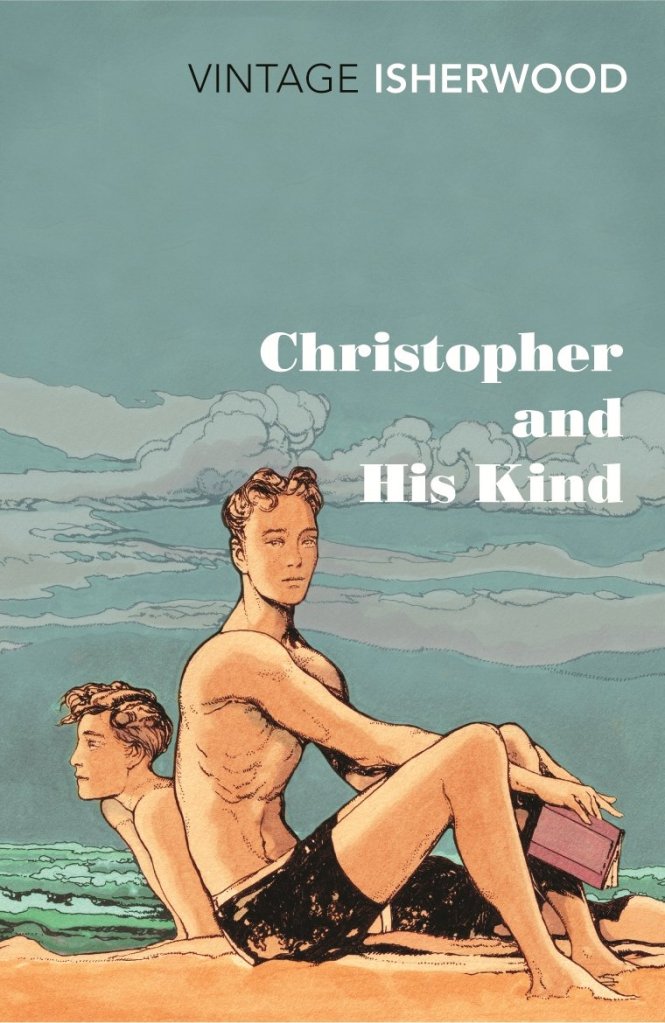
Christopher and His Kind is a 1976 memoir by Christopher Isherwood first printed in a 130-copy edition
I find it rather interesting that you spent thousands of pounds to send your son to this university city. Did he have a choice in the matter? Perhaps not — but in any case, thank you for your thoughtful consideration. He is, as you surely already knew, something of a handful. But did you also know that he grinds his teeth in his sleep?
I tell myself I like people who are “real,” unpolished, unpredictable. Mild Tourettes, ADHD and obsessive-compulsive disorder. Everything that I need in a lover.
He flinches. He repeats. He forgets. I forgive. Again and again. Love as repetition, love as tic, love as pulse.
I tell myself it’s tenderness I’m after, but really, I crave the hum of his disorder. His chaos matches mine.
The script didn’t work. We looked at it for hours… days even… until somebody said… “Ditch the Peter Pan shit, because everybody knows the Peter Pan shit already… focus on Michael, and only Michael, a handsome son of a bitch who Peter Pan would have fucked anyway.”
A few weeks ago, Charlie introduced me to the works of Jacques Tati. We started with Jour de fête (1949) and over a week watched his Monsieur Hulot, featured in Les Vacances de Monsieur Hulot (1953), Mon Oncle (1958), Playtime (1967) and Trafic (1971). I’m late to Tati’s work, but it wasn’t hard to catch up, because he made so few films, and the ones that he did were genius.
Charlie knew I would like Tati’s humour but confessed to knowing little about him. Intrigued to find out more, I bought one of the many biographies and spent warm evenings on the terrace absorbed in the life of this French legend.
Tati had a gentle spirit, and a quiet dignity, but behind the camera he could be elusive, stubborn and emotionally distant. This was easily confused with arrogance and I was left with the impression that he wasn’t a nice person. It troubled me because I discovered too many similarities with the person I lived with. I thought, ‘Fuck me! Is Charlie a reincarnation of Jacques Tati?’
Charlie, who tries hard to be good at everything, but doesn’t really know what it is he is best at. Painting? Photography? Modelling? He’s a complex person, committed to artistic vision – sometimes to the point of obsession – and to an outsider he can seem a bit of a shit.
He’s quite the opposite really, but his devotion to art can seem almost monastic. He pushes for the purity of his vision, as though wanting to leave behind something beautiful, and that pursuit can sometimes be baffling.
I explained this to Charlie, and as the English like to say, he got ‘the face on’. “You do not understand my ache of misunderstood devotion,” he replied. “But I appreciate your concern, because it is mine also, and I need to decide what it is that I am going to be brilliant at.”
A night of drunken defiance, the air outside warm and sticky, carrying the sour breath of alcohol from the open doors. My head feels heavy, my stomach lined with white rum, and the thought of going home to curl up with a Jacques Tati biography feels more attractive than another drink. Still, I order another one – habit, not desire.
Ben messages to see if I’m out, and I can feel the eagerness in his words, the barely disguised hunger. Last week we sat in a corner booth until five in the morning, the world narrowing to the scrape of glasses and the whisper of confidences. But I put him off tonight. Familiarity is dangerous.
I once fell for him and, in a moment of reckless honesty, suggested we sleep together. He brushed it off with a laugh, not knowing that I never give anyone a second chance.
A hillside in the remote countryside. Serge Gainsbourg sang Black Trombone on the iPhone. Charlie danced in his underwear. His hair formed a question mark on his head. He looked cute. I grabbed him from behind and he reached over and patted me on the head like a dog. Then he pissed into the wind and I got covered from behind.







 Perfectly Hard and Glamorous