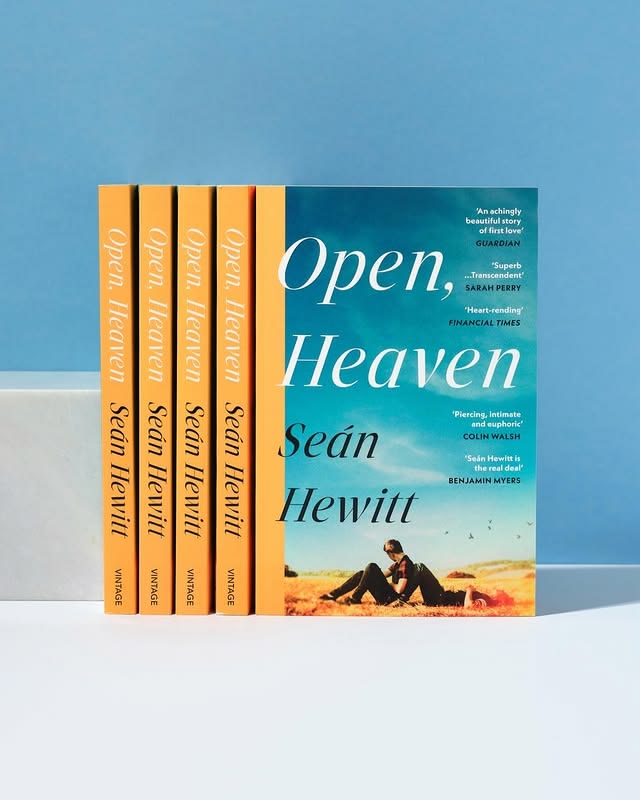
Open, Heaven: Seán Hewitt (2025)
“Now, this nightly ritual had been my secret for years. In my mind, it was linked somehow to that scene – the distance, the watching but never touching. I fixated only on those I thought would not reciprocate, but I could imagine the moment of pre intimacy when they would give in and a secret would be made between us. I understood that this was what desire was: wanting something I could not have, dreaming of holding it. But even then I knew there was a risk, a contradiction: if, by some chance, the object of my desire desired me, I had the sense that the desire might evaporate altogether. So, although there was this burning, urgent thing, I could not exorcise it, and my imagination went into overdrive under restraint. There was never a release, never a completion that didn’t feel soiled and voyeuristic.”
Joshua handed me a pristine paperback. “Read this,” he said. “I think you’ll like it.” The book looked untouched; seeing my hesitation, he added, “I enjoyed it so much I’m giving all my friends a copy.”
I don’t think I’ve ever known anyone do that, and I found myself wondering whether they could really afford such generosity.
But Joshua was right.
The novel is a debut from Seán Hewitt, better known until now as a poet, memoirist, and critic. He is also Assistant Professor in Literary Practice at Trinity College Dublin and a Fellow of the Royal Society of Literature. His first poetry collection, Tongues of Fire, won the Laurel Prize in 2021—the same year he published J.M. Synge: Nature, Politics, Modernism. His memoir, All Down Darkness Wide, followed in 2023, and then came 300,000 Kisses: Tales of Queer Love from the Ancient World; a second poetry collection, Rapture’s Road, appeared in 2024.
Which brings us to Open, Heaven, a debut that confirms him as an all-rounder.
It is, in a way, a love story without quite becoming one—an infatuation we hope will deepen into something more, though it never does.
James, a teenager, dreams of a life beyond his small village; his emerging desires threaten to unsettle his shy exterior. Then he meets Luke—unkempt, handsome, charismatic, and impulsive—sent to stay with his aunt and uncle on a nearby farm.
As the seasons pass, a bond forms between them, one that quietly reshapes their lives. Yet James remains uncertain of Luke’s feelings, and as summer draws to a close, he faces a choice: risk everything for the possibility of love, or let it slip away.
I have a weakness for bad boys, so it was inevitable that I fell for Luke—made all the more appealing by the fact that he turns out to be straight. I was less taken with James, who seems destined to spend the rest of his life wondering, What if I’d forced the issue? Though perhaps that’s unfair. He could just as easily have been me.
I suspect I’ll carry my own catalogue of missed opportunities. Memory has a way of softening the past, making it seem brighter, simpler—chiding you for not taking a chance. But it was never that simple.
Hewitt proves especially perceptive when it comes to these almost-relationships—the ones that hover on the edge of possibility but never quite materialise.
I finished the book still hoping, right up to the final pages, that something might finally happen between them. Afterwards, I read other readers’ responses; the consensus, unsurprisingly, was that it leaves an aching feeling.