
The extraordinary brevity of Guy Copin de Mirabel’s life, and the photograph that brought him back into view
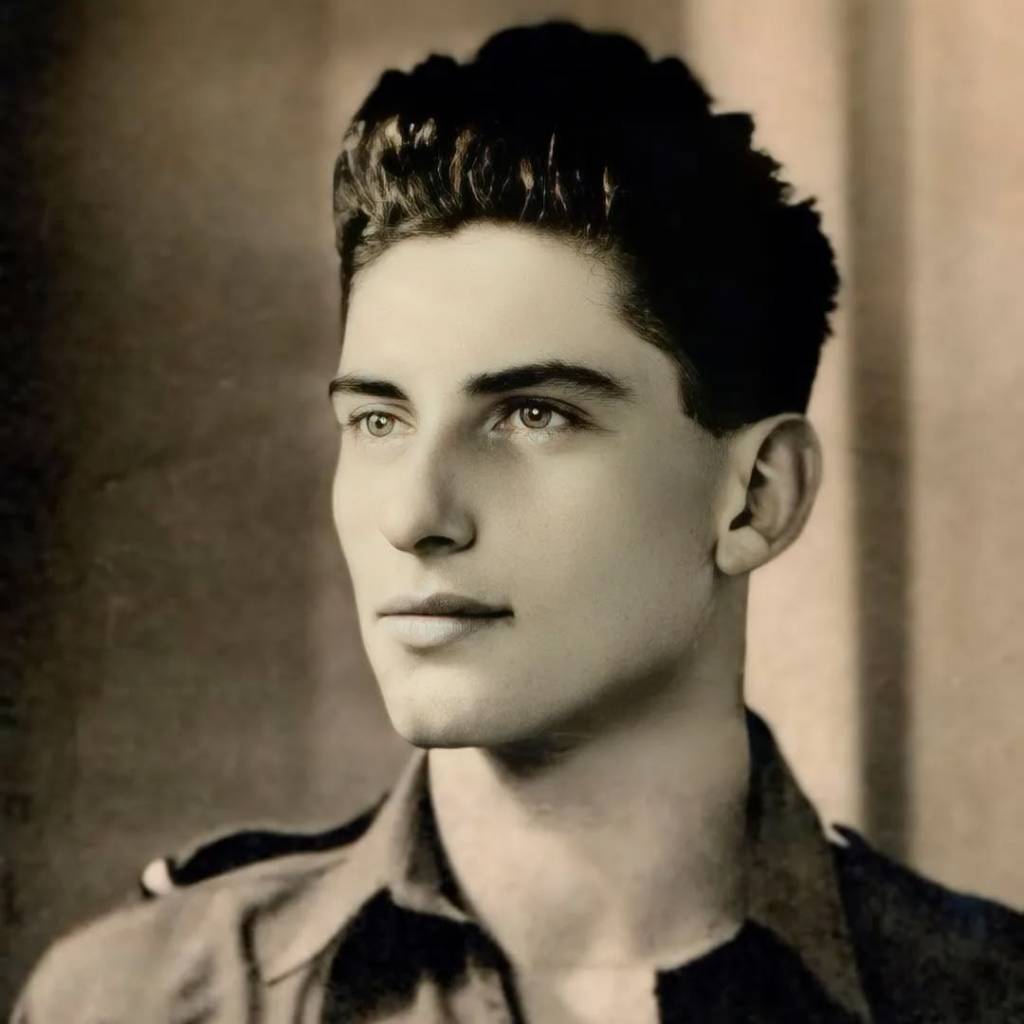
Being sociable, and all that, I happened to browse the Instagram profile of Os Jovens Phidias, where an old photograph of Guy Copin de Mirabel (1925–1947) stopped me in my tracks. A gasp of approval was probably the appropriate response.
The frustration, of course, came afterwards, when I tried to find out more about him.
And that wasn’t easy.
The Copin de Miribel family is an ancient French noble family originating in the Dauphiné region, where it was ennobled in the seventeenth century. With deep Catholic and military traditions, the family has produced distinguished French generals, political figures and social activists.
Guy Copin de Mirabel was born in Paris, the son of Gabriel Copin de Mirabel and Marie Madeleine Amélie Jeanne Charlotte de Préaulx. An extraordinarily handsome young man, he died at just 22 years of age in 1947.
Death, it seems, doesn’t discriminate against male beauty.
Copin de Mirabel served as a sous-lieutenant (second lieutenant) in the 5ème Régiment de Cuirassiers, fighting in French Indochina against the Viet Minh and other nationalist and communist forces. He was killed in action at Lang Khoa, Vietnam, and was subsequently recognised as Mort pour la France — a legal and honorary distinction bestowed upon those who lose their lives as a consequence of war or military service.
And so, from a chance encounter with a photograph, I find myself contemplating a young man whose life was cut tragically short, and about whom so little seems to have survived.
There is something rather poignant about that. We can admire the face, trace the family history, establish the military record and put dates to a life. But the photograph leaves us with something none of those things can quite answer: who was Guy?
For a moment, at least, he has caught our attention again.
And there’s an interesting underlying thought here, too: we encounter Guy first as an image of male beauty, but the more we discover about him, the less comfortable it becomes to regard him simply as a beautiful face. He was a young man with a family, a history and, presumably, a life and ambitions of his own.

