
Salacious

Francesco Wenz, 21, German-Italian actor.
In Strange River (2026), he plays a mysterious boy whom a Spanish teenager falls in love with during a family vacation.
Is his character, Alexander, real or merely a manifested love fantasy?
“The role is very silent; I only have two lines in the entire film, so I could express a lot through my body. Our director liked to use ambiguity as a guideline.”
A boy and a longing. And delicious uncertainty.
Photo by Richard Kranzin.
Rent
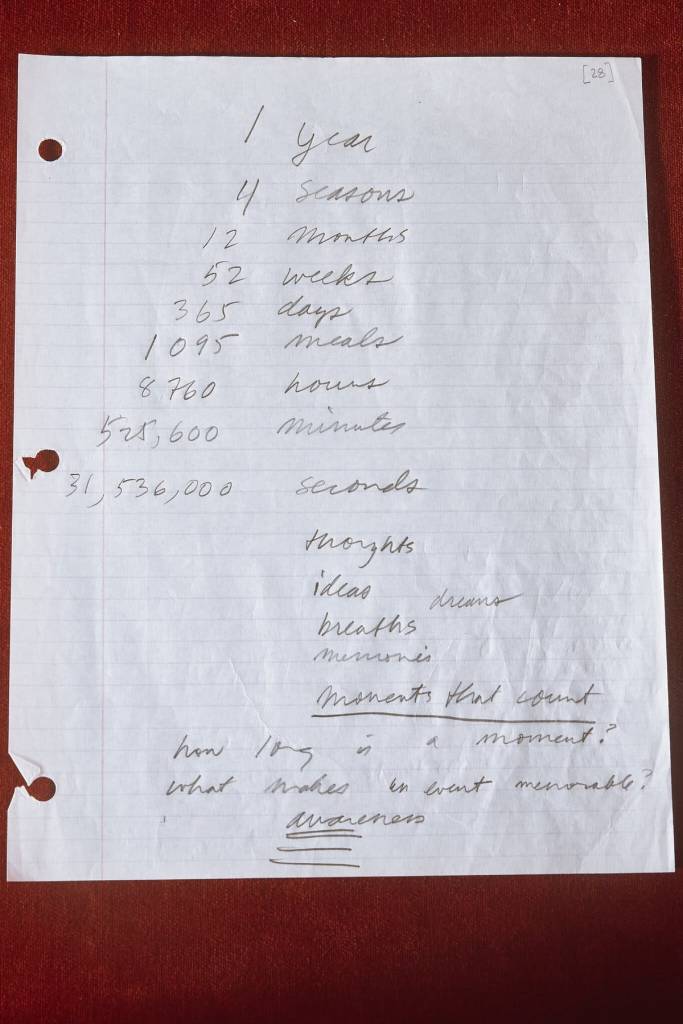
I have a strange fascination with the tragic story of Jonathan Larson, the man who wrote the musical Rent. That might sound a little cruel, and perhaps it is, but there’s something about the circumstances of his death that I find profoundly moving.
It’s 30 years since Rent first appeared on Broadway. Yet Larson never got to see his work become one of the most enduring musicals of its generation. He died unexpectedly in 1996, just hours before the first Off-Broadway preview was due to take place at the New York Theatre Workshop. It’s difficult not to feel the injustice of that.
Last Monday, members of the original cast were preparing to reunite for an anniversary concert.
And here’s another rather fascinating detail.
The Library of Congress holds the Jonathan Larson Collection, some 15,000 items stored in almost five dozen boxes. Notes, scraps of paper, calculations, ideas, often scribbled down and scattered about. It’s rather like being given a glimpse into the workings of a busy mind. If Larson had a thought, it went onto paper.
Among those papers are his calculations for 524,600 minutes, written out on a couple of sheets. That number, of course, became central to one of Rent’s most beautiful and emotionally affecting songs, Seasons of Love.
I rather like the thought that something which would eventually move millions of people began with a few calculations on a couple of sheets of paper.
Pin-Up
I watched Where Angels Fear to Tread, the 1991 British film directed by Charles Sturridge and based on E.M. Forster’s celebrated 1905 debut novel. A rather lovely Edwardian period piece, it explores the cultural divide between repressed British respectability and the more passionate atmosphere of Italy, with all the accompanying social conventions and disapproval.
It has that Merchant-Ivory look about it (it’s not by them), and I could have sworn I’d seen it before.
I hadn’t.
There is, however, one particular standout.
Rupert Graves.
Not necessarily for his acting, but because, my goodness, he was something of a stunner in his younger days.
By then, he had already acquired something of a gay following, largely thanks to his breakthrough role as Alec Scudder, the working-class gamekeeper, in the 1987 Merchant-Ivory film Maurice, another E.M. Forster adaptation. A film that, incidentally, I think is ripe for a 21st-century remake.
Graves himself has attributed some of his appeal to being a young, pretty pin-up figure at the time. I can hardly argue with that.
Which brings me, rather unexpectedly, to The Famous Five. Those Enid Blyton stories I used to read under the bedclothes, long after I should have been asleep.
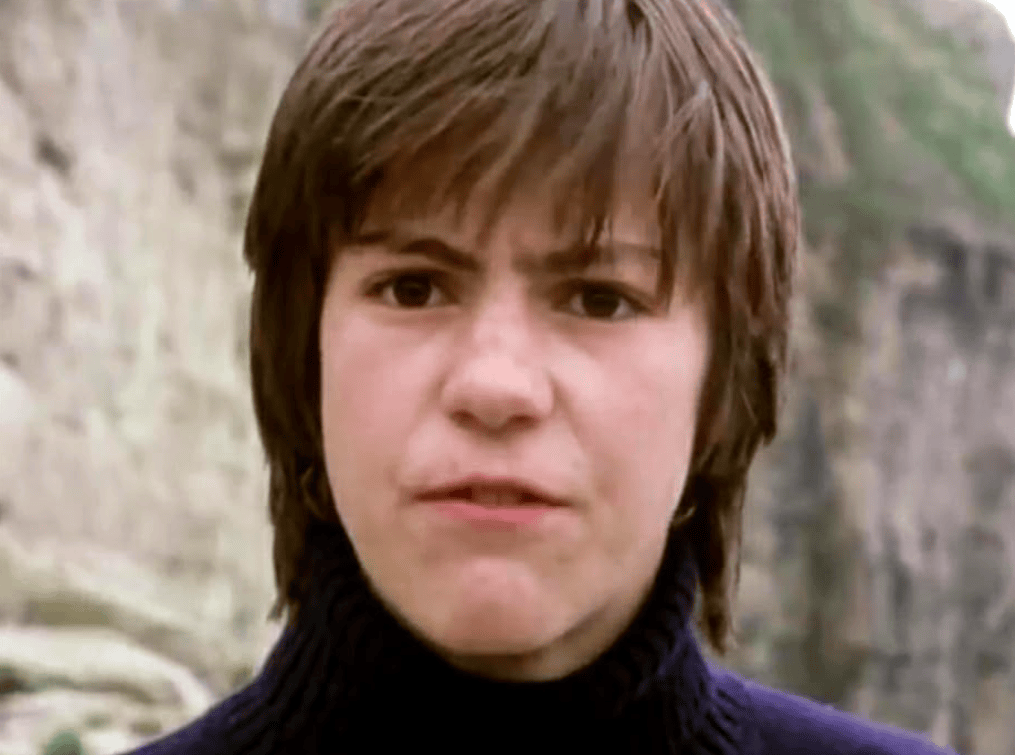
Before making his name in period dramas, a 15-year-old Graves appeared in the classic 1978–79 ITV adaptation, playing Yan, a rather ragged but hugely enthusiastic local boy, in two episodes of Five Go Down to the Sea.
There are clips on YouTube, and even at that tender age, the pin-up potential is already there. Some things are simply evident early on.
For the record, Rupert Graves is now 63.
Snickers

I seem to be disappearing down a classical music rabbit hole. A slightly old-manish occupation, perhaps, but I’m not going to apologise. There’s something rather relaxing about having classical music playing while I write. That’s my excuse, anyway.
Severin first brought the rather handsome pianist Julius Asal to my attention. Now I’ve discovered another classical musician who is equally easy on the eye.
Thibaut Garcia.
A French classical guitarist of Spanish heritage, Garcia has built an impressive reputation, with acclaimed albums including Leyendas (2016), Aranjuez (2020) and El Bohemio (2023). More recently, in 2025, he released his own transcription of Bach’s Goldberg Variations.
He’s also the subject of a documentary, Thibaut Garcia: A Guitar with a View (La guitare au sommet), directed by the renowned music documentarian Bruno Monsaingeon. Sadly, I’ve yet to find anywhere I can stream it. A little frustrating.
There’s another detail about Garcia that caught my attention. Early in his career, he suffered from such severe anxiety before performances that he felt the blood wasn’t circulating properly in his hands. His solution? A strict pre-concert ritual involving a Snickers bar, eaten just before going on stage for a quick sugar boost.
As he got older, he realised that what he was experiencing was essentially stage fright. The Snickers eventually gave way to a rather more sensible 7-5-8 breathing exercise to bring his heart rate down.
So there we are. Talented, stylish, handsome, and apparently someone who needs a little pre-performance reassurance.
I don’t know. He might be a celebrated classical guitarist, but there’s something rather old woman about him. And I mean that affectionately, of course.
Suspended
A social media post got me into trouble.
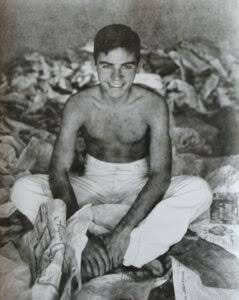
“What I loved about George Platt Lynes photographs was that velvety beauty of them – that’s what I imagined was going to happen to me. So I was very disappointed when I saw the effect of the paper negative that he used. But of course I wouldn’t have told George. I did tell Chris I was disappointed. Yes, oh god, I would rather have had the classic Lynes photograph, but you know, why quibble? I was nineteen, so it didn’t matter.” – Don Bachardy, now 92, American portrait artist, who had a 33-year relationship with Christopher Isherwood.
It was the photograph that caused a problem.
George Platt Lynes’ perfectly innocent photograph of 19-year-old Dan Bachardy got both my Threads and Instagram account suspended for child sex exploitation.
A little AI over-zealousness, perhaps.
But, to be fair, common sense eventually prevailed, after I’d jumped through hoops and banged my head against the ceiling.
Scrapping

I came across an old photograph that caught my eye. A little investigation revealed that it was taken by Paolo Monti (1908–1982), one of the most influential Italian photographers of the 20th century, celebrated particularly for his architectural and documentary work.
Monti lived in Venice for a time and, in 1947, co-founded the influential photography club La Gondola.
Venice, of course, has been making rather a few appearances here lately.
Long before smartphones, video games and all the other distractions of modern childhood, the young Venetians clearly had to find their own entertainment. And here, in the Campo de la Maddalena, we have what I can only describe as the local championship of Venetian street wrestling. Highly competitive, entirely unorganised and, I imagine, with absolutely no parental supervision.
I’m quite certain that some of these young boys grew up to be very handsome young men.
Although I do have a few regrets on behalf of those whose mothers thought matching white shoes and socks were a good idea.
A fashion no-no, even then, surely?
On the Cute and the Willing

A taste of Sacha.
That smouldering eye contact establishes an immediate, intimate connection. A classically homoerotic aesthetic defined by clean lines, subtle jewelry, and an incredibly captivating presence.
It reminds me of a line from Alan Hollinghurst’s The Swimming-Pool Library (1988):
“I looked at him with the sharp, helpless appetite of the lover who sees his beloved in a moment of unconscious grace.”
Photo by Stephane Gizard (2026)

