
Tag Archives: creative

Charlie – The Comfort of Anonymity

Image: Charlie Besso

February ended with an odd remark from Charlie.

“I searched online,” he said, “and found no evidence that you have ever written anything.”

In one sense this was reassuring. I write under an assumed name, after all. Yet it was also unsettling, because the remark revealed that Charlie had been looking. If he were ever to find my work, he might not appreciate how frequently he appears in it.

He forgets that I am blocked from viewing his Instagram page, though that obstacle proved easily solved with a hastily created fake profile.

“Some people prefer to remain anonymous,” I told him.

Charlie cannot understand this. The French boy dreams of fame and dabbles in anything that might propel him towards it. I, on the other hand, prefer the safety of obscurity.

My friend David, a successful author, has written under a nom de plume for decades. As he once explained, “If I knew a book would succeed, I’d happily publish it under my real name. But writers are haunted by failure. Imagine the shame of having that failure attached to the real you.”

I have never had the heart to tell him that his real identity can be discovered by anyone, anywhere in the world.

Charlie might have uncovered my secret already, had he possessed a little more information. A few weeks ago I typed the titles of several of my stories into Google. To my alarm, an AI assistant suggested that they might have been written by me. It had linked three titles to Spotify playlists of the same name on my profile. I quickly changed the account name, but the episode left me with an uneasy realisation: artificial intelligence will always be a few steps ahead of us.

Anonymity, it turns out, is fertile ground for paranoia.

Charlie later recommended that I watch a short film on YouTube.

“It is about a writer with a mental block,” he said, “who rents a summer house and becomes obsessed with a young boy on the beach.” Then he gave me a mischievous wink. “Watch it. It is very you.”

The film was Belgian. It followed Louis, an ageing writer who becomes fixated on Tommy, a young man who visits the beach each day with his girlfriend. The obsession rekindles Louis’s imagination, and in the novel he begins to write he conveniently drowns the girlfriend, leaving Tommy entirely to himself. At least, I think that is what happens. The ending leaves you uncertain whether the events belong to fiction or reality.

Charlie was right. It was “very me”, in the sense that I often begin with a person and build a story around them. What Charlie did not know was how close that description came to the truth. I found myself wondering whether he had somehow hacked into my laptop.

“Why did you search for my work?” I asked.

He hesitated.

“Well,” he said eventually, “I am curious about what you are writing—and whether it is good.”

That was the dilemma. Long ago I realised that I depend on acceptance for survival, and that my writing might reveal far more of my inner life than I would ever willingly confess.

“I’m not sure I could face the shame of criticism,” I said. “Or the possibility of being exposed as incompetent.”

It was meant as an offhand remark, yet it revealed more than I intended.

I half expected reassurance, perhaps even encouragement. None came.

“I suppose we are all afraid that people might see our flaws,” Charlie said thoughtfully. Then he smiled.

“Except, of course, when you do not have any. Like me.” 
Last night I dreamt I was eighteen again

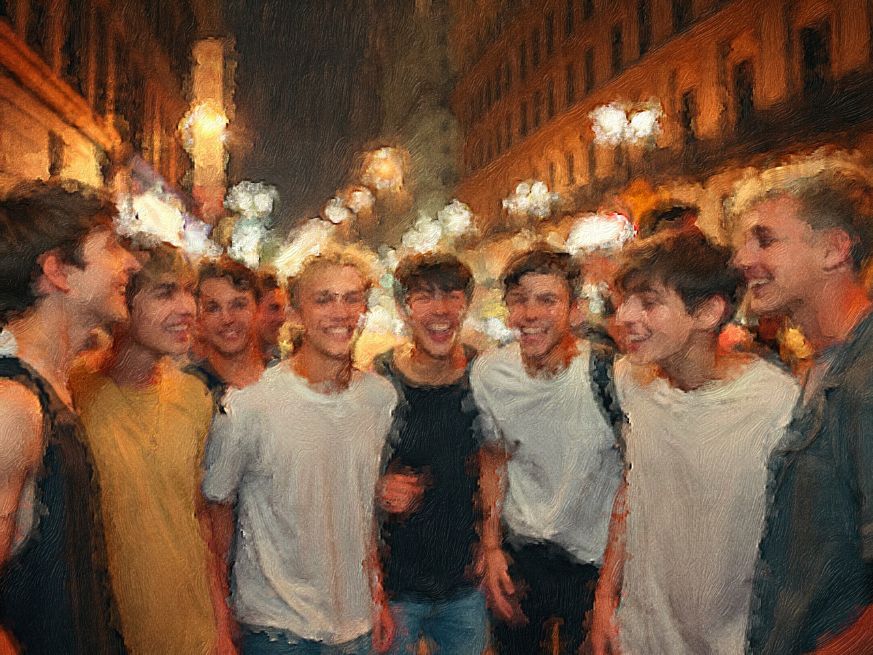
The Boys- Charlie Marseille (2026)

Hormonal Surge: Increased testosterone, fuelling restlessness and the need to discharge energy, sometimes through risky or boisterous play, mock fighting, and testing boundaries.

I wake and can hear music playing in the other room. It is an eighties song – Calling All the Heroes – and it is perfect. My first waking moments are defined by a song made before I was born. It will become a favourite. Whenever I hear it, I will recall the dream.

I’m eighteen. Like I always am. There are twenty boys of a similar age. We don’t know each other, but we have bonded; something connects us, though I don’t know what it is. And now we are friends. Brothers who drink too much, laugh, and joke. We move from bar to bar until the group becomes fragmented, but still we keep bumping into one another — in different bars, on street corners, in dark streets – and each time we greet each other with high fives. I keep losing my coat that contains my mobile phone, but somebody in the group always finds it and saves it for me.”

What am I dreaming about?

Eighteen. Delayed or suspended adolescence. The moment just before categorisation -before ‘out’ or ‘not out’, before relationships are legible, before desire is policed or explained. A moment of pure potential, when attraction, friendship, and self-recognition have not yet been sorted into boxes. A group of boys I don’t know, where intimacy doesn’t have to announce itself as erotic to be real. Touch exists: high fives, a coded language, bodies moving together through night-time space, alcohol loosening edges, and the bond is felt rather than named.

These boys don’t posture. They don’t test me. They don’t ask who I was. They simply accept me. A world that perhaps never fully existed, but felt briefly possible.

The group breaks apart, but there is no need to cling because the bond reasserts itself naturally. “I still know you. You still know me.” I repeatedly lose my coat and my phone – yet I am never punished. I am held by others even when I am careless, distracted, or drifting. I don’t have to hold myself together perfectly. I’m not abandoned for losing my way. A fantasy of uncomplicated male belonging – one where youth, desire, friendship, and identity coexist without fracture or explanation.

The next part of the dream is important.

“There are ten of us staying in a hotel room. It is the only one available. We snack on almonds and slices of apple covered in salted caramel and maple sugar. Two double beds and a single mattress on the floor. When it comes to sleep, we must find space in one of the beds. I choose a double bed where four of us will squeeze together. I’m thrilled that the most handsome boy will sleep next to me. But at the last moment, he is taken. Another boy wants him to share the mattress on the floor, and I am devastated. The dream is never consummated.”

The hotel room matters. It is temporary, improvised, and not designed for this many bodies. I share a bed with four boys. The choice is telling. I don’t choose privacy, pairing, or exclusivity. I choose crowded intimacy – warmth, bodies, breath, limbs overlapping. Proximity without the exposure of being singled out. I am about to be close to the handsome boy without declaring him an object of desire, but he isn’t a person yet – he is a figure onto which desire might safely attach itself. 

The handsome boy doesn’t reject me; he is summoned – pulled away by another boy. Desire is displaced, not denied. My devastation isn’t only about losing him. It is about losing the fantasy of being quietly chosen within the group. But the group has ruptured because somebody else’s desire has rearranged the night. My loss is intimate, quiet, internal – no one else even notices it happening – and so I do not follow. I do not compete. I do not protest. I absorb the loss silently. 

I woke up.

Charlie / Why do they all seem to be called Luka?

Image: India Hobson

Shades of teen. We flicked through pages of photographs hoping to find one to use. The task had become tiresome because there were only so many images of scantily clad guys that you could absorb, and there was a risk that we might choose the wrong one. But we kept looking, thinking that the next page might reveal something better than the one before. “It is like watching gay porn,” said Charlie. “You start watching a video but move on to the next one because you think it will be more exciting but never is.” His reaction caught me by surprise. “This is hopeless,” he continued, snapping the photo album shut, “and why do they all seem to be called Luka?”