The guy asks if I know where he can buy a bag, running a finger under his nose like he’s trying to point out the obvious. We’re standing by the sinks, the mirror cracked just enough to make our reflections look like a bad collage. I know exactly what kind of “bag” he means, and I can’t help him. He grins, shifting his weight from one foot to the other, the kind of restless energy that makes the fluorescent light hum louder. “I’m asking for a friend,” he says, winking. Of course he is.
I wash my hands longer than necessary, partly because the tap sticks, partly to see what he’ll do next. He’s still there, pretending to check his hair, pretending not to care. The door opens, and a rush of laughter spills in from the bar — a reminder that the world outside still exists, bright and oblivious. “Good luck to your friend,” I say, reaching for a paper towel. He laughs, too loud, too quick, like someone who knows the joke’s on him.
This relationship is borderline and has been like this for years. A decade when we changed from boys into men. I have no idea whether this long infatuation has been about love, or lust, or perhaps both. But it is MY infatuation and not his. He sends a message with three short words – ‘YOU DA BEST’ – and I want to screenshot it.
Johnny and Vinny (second and fourth from left) – Danny Fitzgerald (1963). According to, Loncar and Kempster, Fitzgerald never printed this image. It was found in a short, four-frame strip of images of the brothers smoking between two cars with friends, on a street in Carroll Gardens, Brooklyn.
The noisy summer of 1963. Shouts, laughter, transistor radios blasting crooners and rock ’n’ roll. Danny Fitzgerald walked the streets of Carroll Gardens—sixty square blocks of brownstone row houses stretching from DeGraw Street to Hamilton Avenue, and from Court Street to Hicks. The neighbourhood bore the name of Charles Carroll, the only Roman Catholic to sign the Declaration of Independence, and as if on cue, the bell towers of St. Mary Star of the Sea and Sacred Hearts & St. Stephens rang out, reminding Fitzgerald that faith was still the glue holding this community together.
Everybody knew everybody here. Reputations mattered, gossip travelled faster than the summer heat, and though Fitzgerald wasn’t an outsider, he knew that by the time he reached Carroll Park, word of his presence would already have spread. He checked that the roll of ten-dollar bills was still safe in his pocket.
On one corner stood a family deli; opposite it, the bakery, its doorway spilling the smells of fresh bread, sfogliatelle, and espresso, along with the little paper cups of ice that kids clutched in the sun. A neon sign buzzed over the grocery, where a framed portrait of John F. Kennedy hung proudly behind the counter.
Sicilian and Neapolitan voices floated from stoops where old women in black dresses swept steps, aired laundry, and fanned themselves as they traded gossip. Below them, men smoked cigars and talked dockside work while listening to baseball on portable radios. Children darted about—stickball, stoop ball, bicycles weaving down Union Street, dodging cars, or shrieking as they ran through the spray of a fire hydrant on President Street.
Fitzgerald found what he was looking for on Columbia Street: teenage boys in leather jackets and rolled-up jeans, striking poses, trying hard to look older as they flirted with girls.
Johnny leaned against an iron railing, a toothpick lodged in the corner of his mouth, hair slicked so smooth it gleamed in the afternoon sun.
“Johnny! Vai a prendere il pane!” his mother called from the window, tossing him a crumpled dollar bill. Go get the bread.
He caught it with ease, sighed, and stuffed it into his pocket. His buddies leaned against a parked Buick, passing around a cigarette. Johnny joined them, hesitated briefly—his mother waiting for bread—then shrugged. She could wait.
Fitzgerald stepped forward, cautious but deliberate. “Hi Johnny. I’ve got a proposition for you—and your brother.”
In 1963, Danny Fitzgerald was forty-two. A first-generation Irish-Italian, he had only taken up photography in his thirties. He trained at Abraham Goldberg’s gym on Clinton Street, where he gained the trust of the young men who boxed and lifted there. For a few dollars, he persuaded them to pose for what he called “standard beefcake”—half-naked in pouches or bikini trunks. These images sold covertly to private collectors and to Joe Weider, who used them for magazine covers: Young Physique, Muscles a Go-Go, Demi-Gods.
Health-and-fitness publications doubled as discreet erotica for America’s homosexuals, offering a socially acceptable way to admire the male form. For Fitzgerald, the work was both a business and a means of feeding his own desires. He was said to have fallen hopelessly in love with one of his muses, a blonde youth named Orest—“unrequited love is a ridiculous state, and it makes those in it behave ridiculously.”
In the early sixties, Fitzgerald met the striking bodybuilder Richard Bennett, who became his primary model and collaborator. Together they founded Les Demi Dieux—“the demigods”—a venture that presented “sublime, muscled beauties from the streets of Brooklyn, the beaches of New Jersey, and the woods of Pennsylvania.” Bennett often acted as bait, coaxing young men into Fitzgerald’s lens for tastefully erotic photographs.
By 1963, when Fitzgerald approached Johnny and his brother Vinny, his focus had shifted back to the gritty realism of South Brooklyn street life. A ten-dollar bill was enough to persuade a boy to pose; a little more, and one might strip to the waist.
It was a handsome life, but a quiet one. The photographs were rarely seen beyond private circles, and after 1968 Fitzgerald stopped shooting altogether.
He died in 1990, destined for obscurity, until Robert Loncar and James Kempster acquired his archive the following year. They catalogued his life’s work, publishing Brooklyn Boys: Danny Fitzgerald and Les Demi Dieux (1993) and mounting an exhibition. Though the book is now out of print, coveted by collectors, his photographs survive online at a dedicated website. https://lesdemidieux.com
The rediscovery sparked excitement. Critics praised the work for its intimacy, its blend of realism and myth, its ability to capture both the spirit of its era and something hauntingly timeless. For a while, Fitzgerald’s name flickered in the wider cultural conversation. Yet as the years passed, interest faded again. Today, the collection drifts in a liminal space—remembered vaguely, rarely exhibited, and maybe a danger vanishing once more. Its half-life raises a lingering question: how easily can art be lost, even when once found?
Muscle Boy. Photograph from the early 1960s by Danny Fitzgerald and his studio Les Demi Dieux
The warm light of day. A sudden shout. A boy’s voice: “Questa è la fine!” — This is the end! The cry carries over the water, impossible to know which of them called it, only that it came from one of these boys, each charged with careless energy.
“Con petto nudo,” comes the whisper — with bare chest. “Speak it now, or the moment will slip into memory.”
The dares run high: peer pressure, bravado, that fragile seam between recklessness and courage. None of them yet know it, but this is their rite of passage — the pivot between innocence and the pull of adulthood. Here, in the heat, end the rituals, the invisible hierarchies, the unspoken rules of the pack.
The summer outsider watches. Friendship, rivalry, longing, jealousy, innocence, danger — all play out before his eyes. And he understands the cry for what it truly is: not a game, not a dare, but a declaration.
I had been summoned to Piazza Gilardoni, in the shadow of the Chiesa del Santissimo Nome di Maria—an imposing modernist church at Castel d’Azzano, some ten kilometres from Verona. The message had come from Cinzia, relayed with reluctance by Cola. During the drive he blasted Italian rap at full volume, perhaps to stop me asking questions.
We perched on a warm stone bench and waited. Cola, usually chatty, was subdued and chain-smoking.
The bells clanged on the hour. A man pruned branches into a heap outside the church, then stuffed them into a green bin. Another fussed with a watering can, an oddly futile gesture against the bulk of the trunk.
“My mother is angry with me,” Cola said suddenly. “She told me I should never have interfered—and if anything goes wrong, I’ll be the one to blame.”
I opened my mouth to ask what he meant, but at that moment I saw Cinzia and Bianchi crossing the road. For such a small suburb, the traffic was vicious. Cinzia waved, ushering us into a café called Al Quindese.
Inside, she kissed us both on the cheek, whispered something sharp to Cola, and ordered drinks. Bianchi scrolled through his phone, pointedly disengaged, not even looking up when she ordered him a shakerato and the rest of us espressos.
“It’s been a long time since we were last here,” Cinzia said. “Our grandmother grew up nearby. She still lives just around the corner.”
I tried again. “Why is Signora Bruschi angry with you, Cola?”
He faltered, glanced at Cinzia. She only smiled, unembarrassed.
“Perhaps I am the cause,” Cinzia said lightly. “I hoped you’d come today, though I wouldn’t have blamed you if you hadn’t. Cola knew the reason, but apparently he couldn’t tell you.” She shot him a disapproving look.
“I couldn’t,” Cola protested. “You already had a boyfriend—a Frenchman. And when I told my mother, she said we had no right to interfere.”
Cinzia leaned closer. “I’m sorry,” she whispered. “I only try to look after my little brother.” She spoke as though Bianchi could not hear, forgetting – or pretending to forget – that his English was weak.
Bianchi sensed the attention on him and glanced up, puzzled.
“I hope someone will eventually explain,” I muttered.
“Oh, it’s simple,” Cinzia said breezily. “Bianchi is shy. He’ll sit there looking innocent while I say anything I please about him. I could call him a murderer and he wouldn’t know.”
As she spoke, I noticed a man on a high balcony, leaning against a railing where laundry hung. Unshaven, in a crumpled shirt, he looked down on us from his faded yellow building.
“Tell me,” Cinzia asked suddenly, “do you like my brother?”
I hesitated. “I do. Provided he isn’t a killer.”
She laughed, then called something to Bianchi in Italian. He blushed, shrugged, answered. She translated with a mischievous smile. “He says he won’t kill you – unless you break his heart.”
“How could I possibly do that?”
“Bianchi is a baby,” she said, “curious, uncertain. But for now, he thinks he’s in love with you.”
Heat rose in my face. I looked at Cola for rescue.
“Sedici,” he groaned. “Cinzia, the boy is only sixteen.”
I stared. “But you told me he was eighteen.”
“I lied,” Cola admitted. “Otherwise you’d never have gone to the cinema with us.”
Bianchi smiled faintly and fixed his gaze on the Virgin Mary statue outside. Cola muttered something in Italian. Bianchi’s shoulders drooped.
“What did you tell him?” I demanded.
“That you’re only interested in girls,” Cola said smugly. “It’s safer that way. My mother will be relieved.”
Cinzia scolded him in Italian. Whatever she said, it lifted Bianchi’s expression again.
“I do like him,” I said carefully, “but I already have Charlie. And Bianchi… he’s far too young.”
“In Italy, age is not the same concern,” Cinzia replied. “The law is fourteen, regardless of gender. And Bianchi is capable of marvellous things.” Her eyes glinted wickedly. “He can squeeze the juice from an orange with the cheeks of his buttocks.”
Bianchi understood enough to flush crimson. Cola looked guilty, and I seized the chance to turn on him.
There was a long story behind my relationship with Signora Bruschi – and the apartment. I was about Cola’s age when I first met an Italian boy named Nico and moved to Perugia. Those were long, hot summer days and steamy nights, but autumn soon cast its shadow over the affair. Quite frankly, we grew bored of each other. Being a free spirit, I hopped on a train to Milan.
That was where I met Pietro Mancini, an older gentleman with decidedly queer tendencies, who owned a large accountancy firm with branches in Turin, Milan, and Verona. I enjoyed the attention: the fine clothes, fancy restaurants, lavish holidays, and an endless supply of money. In return, I excused his camp mannerisms and tiresome gestures. I was his toy—his plaything—a good-looking boy at his beck and call.
Until I discovered there was nothing exclusive about this arrangement.
When Pietro suggested I move into his rented apartment in Verona, I saw it as the next step in what felt like a dreamlike adventure. Since he spent most of his time in Milan, I was spared his unwelcome advances and free to live as I pleased. Verona suited me, and it was there that my friendship with Signora Bruschi and her son, Cola, began.
On the day that Cola blurted out: “Is it true that you like to fuck boys?” His mother promptly clouted him on the head with a wooden spoon, but he pressed on: “Signor Mancini has a boy in every town, but I’m glad it was you who came to Verona.” I had been naïve enough to think I was the only one. His words made perfect sense, and the warning bells began to ring.
I didn’t begrudge Pietro his indulgences, but selfishly, I worried that I might fall out of favour and be cast aside when it suited him. On his next visit to Verona, over dinner in Piazza Bra, I demanded the truth. That was when I learned about Severin, a German boy in his Turin apartment, and Elio, my Italian replacement in Milan—apparently his favourite. “Italian boys are more cultured than English and German boys,” Pietro told me.
At Christmas, Pietro invited me to Milan, where I met Severin and Elio for the first time. He expected us to get along, but little was said between us. After a festive meal at Bulgari Milano, and more than enough drink, we realised we were all victims of his lustful whims. A conspiratorial bond formed between us.
In the new year, I returned to Verona, expecting Pietro to arrive on business the following week. On the day of his arrival, I went to Verona Porta Nuova to meet his train, but he wasn’t on it. I returned to the apartment and waited. That night, Elio called: Pietro had dropped dead of a heart attack.
Signora Bruschi was kind and told me I could stay in the apartment. I explained I couldn’t afford the rent, but she insisted it would not be a problem.
In the months that followed, with no money coming in, I lived on the Bruschi family’s generosity. Pietro’s affairs were slowly unravelled, and eventually his will was read. Nineteen-year-old Elio inherited the bulk of the estate, including the Milan apartment. Severin and I received only nominal sums—decent, but since the Turin and Verona apartments were rented, we were effectively homeless.
With little Italian and no job prospects, I left Verona and returned to the UK.
The apartment, however, was kept clean and tidy by Signora Bruschi, who insisted it remain empty and always available for me if I visited. The last time had been fourteen months ago—before Charlie gate-crashed my life.
Charlie messaged me in the morning, as I knew he would. Despite the thousand kilometers between Paris and Verona, he stirred my guilty conscience, even though I hadn’t felt guilty when I went to bed.
What did you get up to last night?
Cola had dragged me to the cinema with Cinzia, and along the way, we picked up her younger brother in Castel d’Azzuno. “This is Salvo,” she said as the young boy got into the back of Cola’s car. “But we call him Bianchi, and he doesn’t speak much English.”
Bianchi turned out to be eighteen, but his small size made him look much younger. Cola had been right; there was no doubt that he was beautiful, with a delicate face, inquisitive dark eyes, a dainty nose, and thick black hair. He nodded, sat beside me without saying a word, and put earbuds in to listen to music on his phone.
We drove to the UCI multiplex on Via Monte Amiata to see Caught Stealing, or as it’s known in Italian, Una Scomoda Circostanza, starring Austin Butler, whom I found both weird-looking and handsome at the same time.
Cola and Cinzia sat together while I was between Cinzia and her brother. I tried to make small talk with Bianchi, but the language barrier proved difficult, and we both fell into awkward silence before the movie started.
Caught Stealing had been dubbed into Italian, which put me at a disadvantage because I struggled to follow the narrative. Cola had suggested we go to a smaller cinema where it was being shown in its original form with subtitles, but I thought this would be unfair to them.
The tradition of dubbing English-speaking movies into Italian dates back to a time when most of the population was illiterate and struggled with subtitles. Mussolini’s government saw dubbing as an opportunity to control foreign content, and the rise of the industry with skilled voice actors has persisted ever since.
I cast furtive glances at Bianchi, who seemed distracted, disinterested, and perhaps even guarded. Once or twice, he looked my way and smiled with embarrassment, but for the most part, he looked away.
He was a beautiful boy, but Cola’s sly yet playful attempt at matchmaking was never going to work because of the age difference.
Afterwards, we went for coffee. Cola and Cinzia spoke in English, and Bianchi listened and smiled as though he was part of the conversation. There were fleeting glimpses of curiosity and connection. What had begun as a seemingly casual setup gradually revealed the possibility of a deeper attraction, or at least a moment of recognition between us.
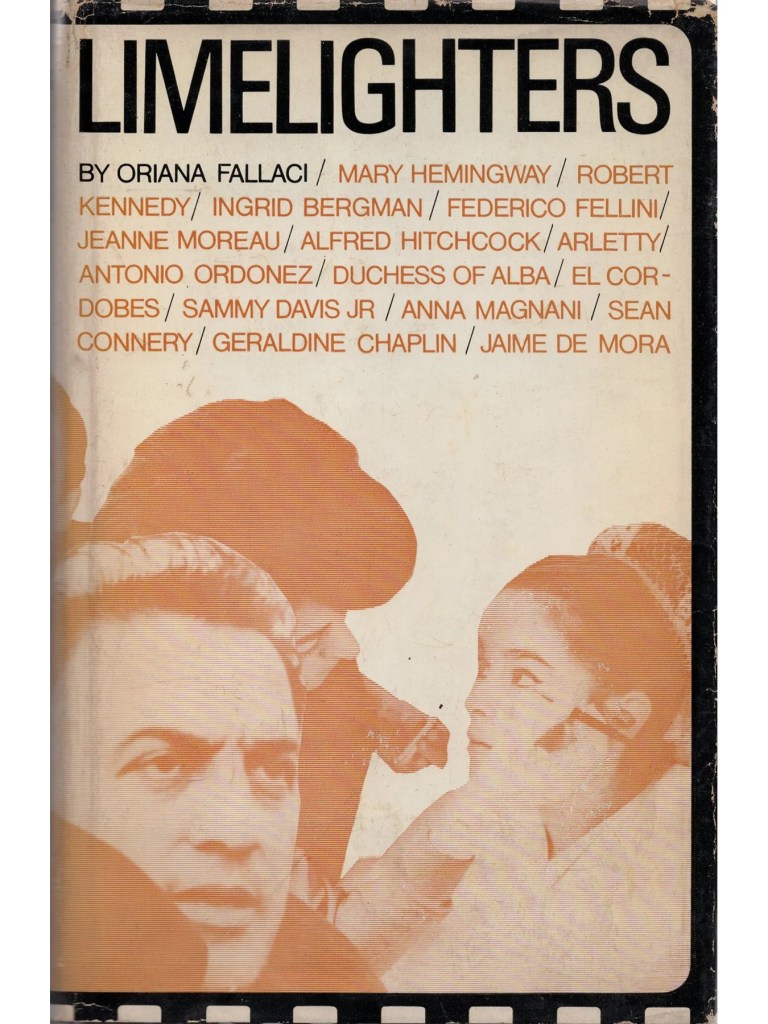
The night was still young as I sat quietly on the terrace, immersed in a book I had recently purchased from a second-hand bookstore back home. The book in question was an English translation of Oriana Fallaci’s work, originally titled Gli Antipatici and published in 1963. My edition bore the name Limelighters, and the author had thoughtfully explained that the Italian title did not lend itself to an easy English translation. According to Fallaci, “When Italians say antipatico, antipatici in the plural, they mean someone that they dislike on sight, and so if I was forced to choose a translation for antipatico, I would say unlikeable.” This explanation, rather than clarifying matters for me, added to my confusion, especially as I struggled to grasp Italian nuances.
The book is a collection of interviews with notable personalities; all recorded for the Rome newspaper L’Europeo using a portable tape-recorder. It begins with the line, “Many of the characters who figure in this book are my friends.” Fallaci proceeds to write friendly and insightful pieces about the stars of her era, including Bergman, Fellini, Hitchcock, and Connery. My bewilderment stemmed from the apparent contradiction between the book’s title and the content, which was anything but unlikeable in its tone and approach.
Most of the fifteen personalities featured in the book, along with Fallaci herself, have since passed away. The chapter that resonated most with me focused on El Cordobés, the Spanish matador and actor, who was still alive. Fallaci masterfully depicted his wild lifestyle: “he buys lined and squared exercise books, but then leaves them blank,” a habit I found relatable. She described him as being constantly surrounded by an eclectic group—banderilleros, priests, lawyers, in-laws, guitarists, boys from his cuadrilla, photographers, chauffeurs, Frenchmen intent on writing his biography, and a brunette whom he had just picked up in Granada. By tomorrow, he would have grown tired of her, and another would take her place. El Cordobés’s story captivated me; I imagined myself as one of the jealous boys from his cuadrilla.
At around seven o’clock, Cola called and mentioned that he was taking Cinzia to see a film, asking if I would like to join them. I declined, but he persisted, suggesting that my presence might encourage Cinzia’s younger brother to come along. “Bel ragazzo,” he confided with a wink.
Wearing an Inter football shirt, he showed little urgency in leaving and spent time browsing magazines before casually flicking through the international edition of the New York Times, which failed to capture his interest.
Cola never displayed any reservations about my homosexuality, even though I had kept this aspect of my life hidden from him when he was younger. I recall being invited to dinner by Signora Bruschi when Cola was about fifteen. After we had finished our Bistecca alla fiorentina, Cola rested his chin in his hands and, with the innocence of a choirboy, asked, “Is it true that you like to fuck boys?”
I had never been to Lake Garda before, and I was surprised by how much it reminded me of the coast. The water was a soft turquoise, rippling with silver and white crests. The hills rolled gently, dotted with olive groves and cypresses. Braccobaldo Beach turned out to be a mix of pastel colours – terracotta roofs, lemon-yellow houses, pale pink facades – and construction sites.
Cola took me to the pebbly beach where his friends hung out and introduced me to Leo and Sandro. His girlfriend, Cinzia, came from San Giorgio in Salici. She relaxed on a sun lounger, attracting attention from cheeky young Italian boys who had arrived on scooters. Cola sat glaring at them, but he needn’t have worried because it was obvious that Cinzia was in love with him. She spoke in English (because it was better than my Italian) and wanted my views about Donald Trump and Giorgia Meloni, who she plainly didn’t like.
Cinzia asked what I did for a living, and I told her that I was a writer, which sounded grander than it was meant to be. I explained that the novel I was writing, if it ever got published, would struggle to sell because only romantic fiction was keeping the book market alive. She raised an eyebrow when I told her that people had moved on from Harry Potter and were now interested in raunchy romantasy books.
The boys went swimming in the lake, and we watched as they grappled and tried to duck each other underwater. These were the last antics of teenage boys, a final celebration before they became men. All three were dark and handsome, but skinny Cola towered above the others. They had known each other since school, Cinzia told me, and were inseparable, but that was about to change. Leo was training for the army, Sandro was joining the Carabinieri, but she was unsure what the future held for Cola.
I asked how he was able to afford a brand new Abarth 500, and she laughed. It was not his car; it belonged to a signor from Torricelle who liked Cola and let him use the car in exchange for doing jobs around his big house in the hills. Cola was very skilful, she said, and could put his mind to anything that involved manual work. He was not, she added with sarcasm, very good academically. And she worried about what might happen if the signor dispensed with his services.
When I crawled into bed, it was so hot and humid that I struggled to sleep, making do with an electric fan and open windows. But Verona came alive early and just as I was about to drop off, the traffic, and sirens from the ‘ambulanzas’ on route to Borgo Trento, denied me the pleasure.
I blinked through the morning until there was a polite knock. Fragmented dreams stumbled into consciousness. I tried to ignore the short taps, but whoever it was wasn’t going to go away. I climbed out of bed, with eyes that felt like sandpaper, and opened the door.
It was Cola. “Buongiorno,” he quipped. “My mother told me that you had returned.” I let him inside and noticed how tall he had become. He frowned at my unruly appearance and held up a bag of fresh cornetti. “I shall make coffee, and you must tell me where you have been for so long.”
I had known Signora Bruschi’s son since he was fifteen, from days when the skinny boy sat on the front doorstep and made cheeky remarks to ladies who passed by. His mother warned him that it was not how good catholic boys behaved but she already knew that Nicola was a lost cause. “He takes after his father,” she had confided, “and has such a violent temper.”
Cola had taken a shine to me after I’d stayed here the first time. He waltzed in and out and helped himself to the contents of the fridge. Then he would beg me to play football with him on the campo giochi until the light started to fade. “He treats you like a big brother,” Signora Bruschi told me. “You are a hero to him, and I pray to St. Gianna Beretta Molla that he will follow your good ways.” The fact that I hadn’t kept in touch bothered me.
Cola was eighteen now, still skinny, but he towered above me. I pulled on a tee shirt and sat at the table while he made coffee.
“What have you got planned for today?” I had hoped to wander through the day without an agenda but sensed that this might be about to change.
“Nothing,” I volunteered.
“Then let me take you out in my new car.”
Cola’s strong coffee wasn’t to my taste. I would have preferred a latte but Italians regard this as sacrilege and so I accepted it without comment.
“My mother says that you have a French boyfriend.” He waited for an answer, but I didn’t respond.
The truth is, I’d argued with Charlie before coming here and was annoyed with him. When he snapped at me, I’d matched his gallic temperament with a dose of Anglo-Saxon home truths. Afterwards, he had sullenly caught the Eurostar to Paris, and I had come to Verona, to the apartment that was rarely used.
Buckle up, hot shot. Time to take flight… and land with impact.
Cola’s new car turned out to be a bright yellow Abarth 500 that he drove too fast. I tried to ignore his erratic driving as I did the alarm bells that were hammering inside my head. How many teenagers could afford a car like this? As far as I was aware, Cola didn’t have a regular job, and I feared that he was mixing with the wrong people, something that was easy to do in Italy.









 Perfectly Hard and Glamorous