
A Better Story
Murder had played an unexpectedly large part in David’s life. Not because he had murdered anyone—he hadn’t even come close—but because he enjoyed telling people about the occasions when he had very nearly been murdered himself. As the years passed the stories acquired new details, sharper dialogue, darker motives. Each retelling nudged them a little further from the truth until even David struggled to remember where fact ended and invention began. He had discovered that almost any story improved if murder was lurking just off the page.
The first attempt on David’s life, if it could be called that, happened when he was fifteen and at Harrow.
By then his sexual inclinations were no secret. They had earned him plenty of abuse, but they also gave him a certain currency. Hormonal boys were inventive when privacy was scarce, and David, more curious than ashamed, was often willing to oblige. It was a contradiction he understood only years later: the same boys who mocked him in daylight often sought him out after lights-out.
For a long time he toyed with writing a novel set during those years. The Edwardian public-school romances had always struck him as curiously bloodless, as though adolescence consisted entirely of cricket, Latin and noble sacrifice. His version would be rather different. His boys listened to the Boomtown Rats and John Peel on Radio 1, smoked where they shouldn’t, and discovered one another in darkened dormitories after the masters had gone to bed. It would have been a scandalous book, especially as David himself had been expelled only weeks later. Better, perhaps, that it remained unwritten.
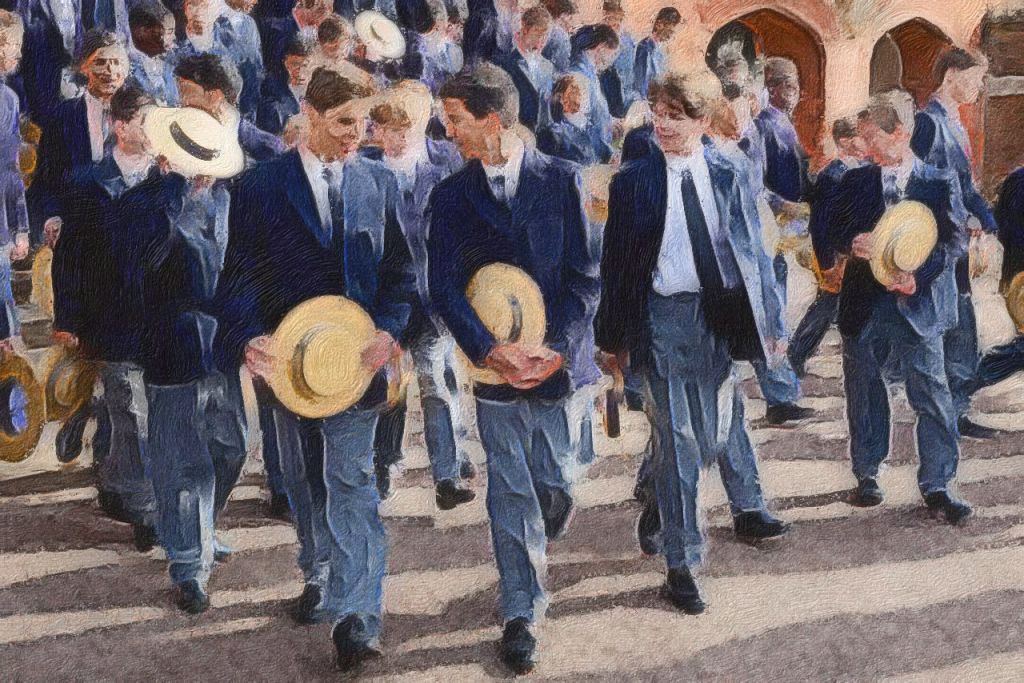
Harrow still clung to customs that belonged to another century. Boys leaving the school grounds were expected to wear full uniform and touch their hats to passing adults. David found the ritual faintly ridiculous. Rules, after all, acquired their greatest attraction once they were forbidden.
He waited until the evening bill had been taken and supper was over. After lock-up, when nobody was supposed to leave the building, he slipped into civvies, climbed the wall at the edge of the grounds and disappeared into the darkness beyond. October had stripped the evenings of warmth, and beneath the heavy oaks and sycamores that crowned the hill he could move almost unseen.
The escapade itself was childish. Getting back in was the dangerous part. It depended on the loyalty of the other boys, who envied his nocturnal excursions even if they had little interest in accompanying him. Nobody informed. To dob in another boy was to spoil the game for everyone. If he had been caught, the punishment would probably have been a few strokes of the cane—a prospect David found less alarming than he cared to admit.
When he finally crept back into his room, there were always faces waiting in the darkness.
“Well?”
The truth was usually disappointing. Harrow on the Hill was remarkably uneventful after dark, looking much like any other sleepy English suburb. But that hardly mattered. David had already begun to understand that the adventure itself was never as satisfying as the story told afterwards.
David often visited the washrooms at the underground station on College Road. Someone had told him it was where people like him eventually ended up. He rarely found anyone of interest. This time there was an older boy, probably in his late teens, pretending to take a piss. David fancied him immediately: tall, fair-haired, slim, with the easy build of someone who played sport. He knew at once why the boy was there.
David felt the familiar surge of excitement. He busied himself by tucking his shirt into his trousers for the third time, then crouched to retie a shoelace that didn’t need tying. The older boy glanced around before slipping into one of the cubicles. David followed without hesitation.
The cubicle wasn’t what he’d imagined. It reeked of piss and shit, and the floor was ankle-deep in sodden toilet paper. It was enough to puncture the fantasy.
“How old are you?” the boy asked, pinning David against the back of the door.
“Eighteen,” David lied.
The boy thrust his tongue into David’s mouth. His breath tasted of cheap fags and Mars Bars.
David had waited a long time for this moment.
Then something gave way inside him.
He opened his eyes and found himself staring at the graffiti on the wall. Names. Telephone numbers. Obscenities. He suddenly didn’t want the boy touching him. He shoved him backwards. For a split second he thought the boy might hit him. Instead, David fumbled with the lock, yanked the door open and bolted from the cubicle. Seconds later he was out of the station and running.
He ran most of the way back to school, stopping only once to make sure he wasn’t being followed. The street behind him was empty. He realised he had been frightened. More than that, he was furious with himself for making such a fool of himself.
He scrambled over the school wall, knowing that once he was inside he would be safe. But in his haste he mistimed the drop on the other side and crashed into a stack of bricks piled beneath it. Pain shot through his knee. When he looked down he saw that his jeans had ripped. He touched the tear and his hand came away covered in blood.
“Shit.”
He limped back to Bradbys and slipped in through a fire door he had wedged open earlier. The room he shared with Gilles was on the top floor, and by the time he reached it his knee was throbbing.
As expected, Gilles was in bed reading a paperback by the light of a torch. David was still out of breath. When Gilles shone the torch at him, it was obvious he’d been crying.
“What on earth has happened?” Gilles demanded.
“Somebody tried to murder me,” David said.
He hadn’t meant to lie. It was simply that the story sounded better than the truth.
So he told Gilles about the man who had lured him back to a room near the station and held a Swiss Army knife to his throat. During the struggle, the blade had caught David’s knee before he somehow managed to break free.
“You mustn’t tell anyone,” he said.
The following morning David visited Matron to have the wound dressed. He explained that he had fallen while running down the stairs. She listened patiently, although the look on her face suggested she had heard rather better lies from schoolboys over the years.
After that, the story escaped him.
By the end of breakfast David was the talk of the school. Gilles had never been capable of keeping a secret. Boys stopped David in corridors and on staircases, eager to hear about his brush with death.
“It was nothing,” David said with studied modesty. “The man told me he was going to kill me, but I fought him off and got away. Just don’t tell anyone.”
Over the following days the tale grew with each retelling. The knife became longer. The struggle more violent. The escape more miraculous. Every version won him a little more admiration, especially from boys who had barely noticed him before.
By an extraordinary coincidence, events beyond the school gates began to lend David’s invention an air of credibility.
One evening he returned to his room to find Gilles waving a copy of Harrow Midweek.
“Listen to this,” he shouted excitedly.
He read aloud.
“We are aware of certain incidents in the Harrow area. People have been threatened—one involving a knife—and several have been assaulted. In June and August, the ‘Gay Ripper’ stabbed two men to death in their homes in Enfield and Kingston.”
Gilles lowered the newspaper and stared at David.
“That might have been you.”
David merely shrugged, although not without a flicker of guilt.
It never occurred to him that a story of this magnitude might eventually reach the masters. Had anyone believed it, the police would almost certainly have been called, leaving David with some awkward explanations to make.
But there were signs that the staff had already decided exactly what it was: another elaborate schoolboy fantasy.
One afternoon David was crossing the quad when his English master, Mr Potts—a bearded man known to generations of boys as Caractacus Potts—called him over.
“I hear you’ve been making up stories, David.”
He paused just long enough for David to wonder whether he was in trouble.
“Very entertaining,” Mr Potts said with a smile. “Perhaps you should think about writing a book.”
Decades later, David would tell the story again. The knife had become sharper, the struggle longer, and the escape even narrower. He had long since forgotten where the truth ended and the story began. But whenever he reached the part about the Swiss Army knife, people always leaned forward. And that, he decided, was what really mattered.

