In the Absence of Men: Philippe Besson (2001)
“First, you take me in your arms. Your immediate, instinctive reaction is to touch me, to press against me, to impress your body on mine, to wait for the moment when they are in symbiosis, the moment when marriage makes them one flesh. First, you seek out my lips, you sketch out a kiss, you find my tongue, our saliva blends. First, there is this irresistible passion, this need for one another, for sensual intimacy. First, you are silent, you do not say a single word. The room is filled with our silence, filled with the sound of bodies brushing against each other, with the sighs of mingled mouths. It is the most sensual of silences, one which says all there is to know about who we are, what binds us, what our future holds. I leave everything to you. More than that, I expect you to behave like this.”
― Philippe Besson, In the Absence of Men
Can you smell the sweat of two naked bodies? Feel the passion between them? And perhaps, more importantly, can you bear the anticipation of what might happen next?
I first read In the Absence of Men on a train from Newcastle to London. Although, strictly speaking, I didn’t quite finish it on the train. I still had the closing chapters to go when we pulled into King’s Cross, so I had to continue reading on the Tube. Not quite the setting I’d have chosen for the novel’s poignant conclusion, but needs must!
The book has stayed with me ever since.
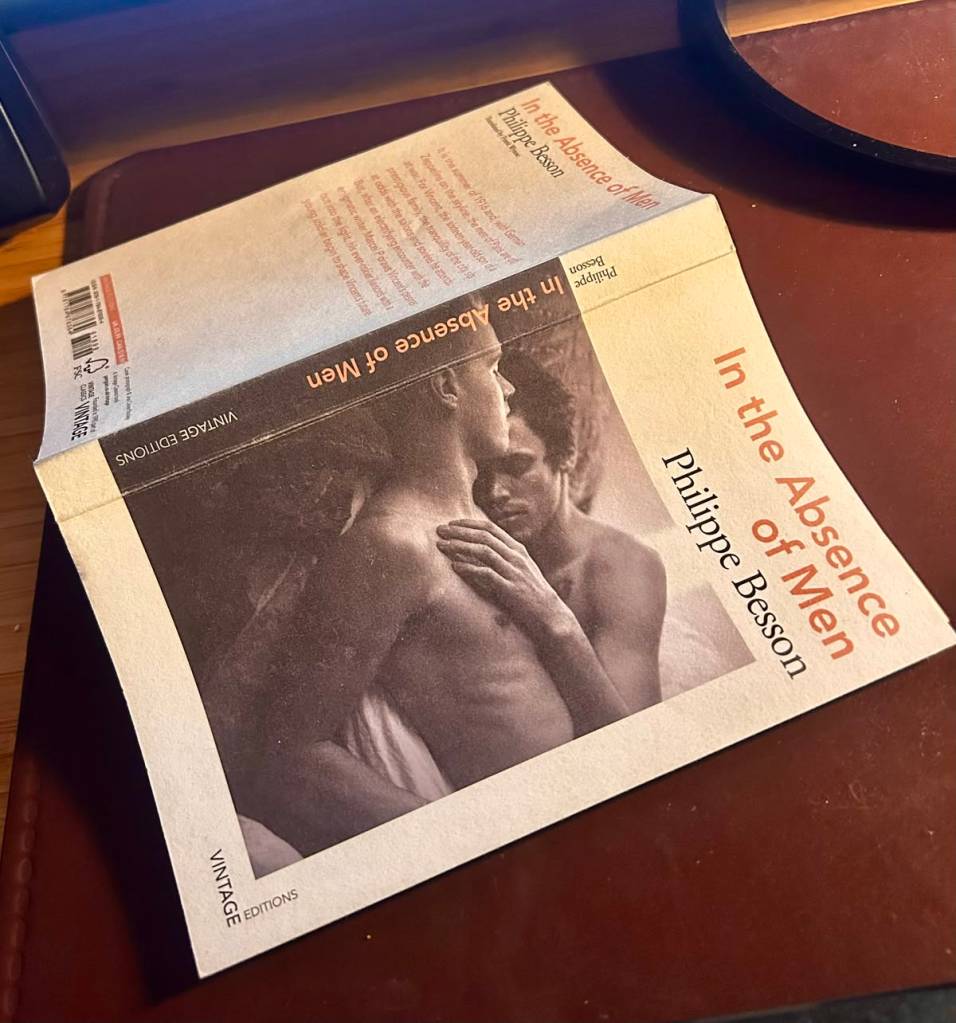
In the Absence of Men (En l’absence des hommes) was Philippe Besson’s debut novel, published in 2001, and winner of the Prix Emmanuel Roblès.
Set during the First World War, it is a coming-of-age story of first love, desire and, ultimately, heartbreak. Vincent is sixteen, and finds himself falling for Arthur, a young soldier whose destiny lies on the battlefields. Along the way, Vincent also strikes up a friendship with Marcel, a celebrated French writer (none other than Marcel Proust). An intriguing combination, I’m sure you’ll agree.
The second part of the novel unfolds through a series of letters exchanged between Vincent and Arthur, and Vincent and Marcel. As the war progresses, the story becomes increasingly heartrending, exploring the emotional cost of conflict and the fragility of love when the future is anything but certain.
Besson, born in 1967, is openly gay, and questions of homosexuality, identity, desire and first love have featured prominently throughout his fiction and autobiographical writing. He writes about these things with a particular tenderness, often capturing the excitement and vulnerability of discovering love for the first time.
He has also spoken warmly about his own experience of coming out:
“I was lucky to have liberal, loving, understanding parents. I didn’t think the revelation [of my sexuality] would be a problem for them. I had this intuition it wouldn’t go too badly and it didn’t,” he said.
And perhaps that’s part of what makes Besson’s writing so appealing. He understands that first love is rarely just about falling for someone. It’s about discovery, longing, uncertainty and all those deliciously complicated feelings that come with it.

