
“Thus began a friendship entirely different from any Gordon had known before. He did not know what his real sentiments were; he did not even attempt to analyse them. He only knew that when he was with Morcombe he was indescribably happy. There was something in him so natural, so unaffected, so sensitive to beauty. After this Morcombe came up to Gordon’s study nearly every evening, and usually Foster left them alone together, and went off in search of Collins.
“Indeed this friendship, coupled with his admiration for Ferrers, was all that kept Gordon from wild excesses during the dark December days and the drear opening weeks of the Easter term. During the long morning hours, when Gordon was supposed to be reading history, more than once there came over him a wish to plunge himself into the feverish waters of pleasure, and forget for a while the doubts and disappointments that overhung everything in his life. At times he would sit in the big window-seat, when the school was changing class-rooms, and as he saw the sea of faces, some big, some small, who had drifted with the stream, and had soon forgotten early resolutions and principles in the conveniently broadminded atmosphere of a certain side of Public School Life, he realised how easily he could slip into that life and be engulfed. No one would mind; his position would be the same, no one would think worse of him. Unless, of course, he was caught. Then probably everyone would turn round upon him; that was the only unforgivable sin – to be found out. But it was rarely that anyone was caught; and the descent was so easy. In his excitement he might perhaps forget a little.”
I have never quite understood what all the fuss was about.
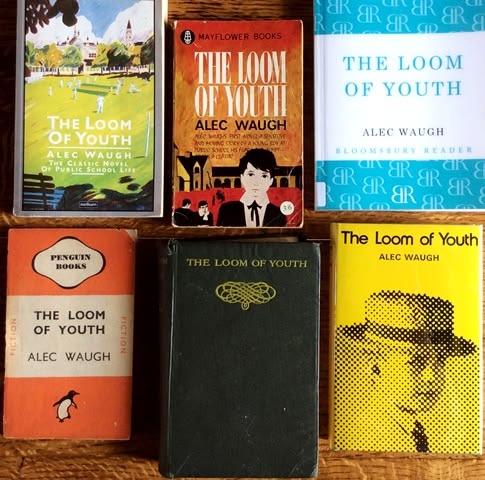
When The Loom of Youth by Alec Waugh was published in 1917, it provoked a minor literary scandal.
Written when Waugh was just seventeen and a half, the novel is both a realistic and romantic portrait of the early twentieth-century British public school system. Through its protagonist, Gordon Caruthers, he explores the complex social hierarchies, academic pressures and personal relationships that shape life at the fictional Fernhurst School.
The novel broke long-standing Victorian taboos by acknowledging the romantic and homosexual attachments that could develop between schoolboys, although by modern standards its treatment is remarkably restrained.
Indeed, the two passages reproduced above are about the only real indication that Gordon Caruthers and his fellow pupil, Morcombe, shared anything approaching a romantic attachment.
Contemporary reviews were, for the most part, favourable, though many cautiously skirted around the subject, resorting to euphemisms such as “immorality”, “decadence”, “sentimental relations” and “unhealthy” adolescent behaviour.
The fiercest opposition came not from the literary press but from conservative periodicals, educational journals and coordinated letter-writing campaigns organised by public school authorities, who regarded the novel as a damaging attack on their institutions.
Waugh depicted a world in which schoolboys cheated, schoolmasters were often out of touch, and both could become easy targets for the casual cruelties of adolescence.
He also challenged the Victorian conviction that team sports—particularly rugby and cricket—instilled the moral character and leadership required to govern the British Empire.
Then there was the schoolboy slang, which horrified many critics and parents, who dismissed the dialogue as vulgar, ungentlemanly and symptomatic of cultural decline.
As Waugh had himself been educated at Sherborne School in Dorset, the school quickly recognised itself as the model for Fernhurst and regarded the novel as a profound betrayal. By exposing the realities of life inside one of England’s elite public schools, Waugh opened institutions that had long been shielded from public scrutiny and, in the process, stirred anxiety among parents and former pupils alike.
Sherborne believed it had little choice but to expel him from its old boys’ association, the Old Shirburnian Society.
Reading it today, it is difficult to see what so alarmed its detractors. What once seemed a shocking exposé now reads as an unusually perceptive, and surprisingly tender, account of adolescence.

