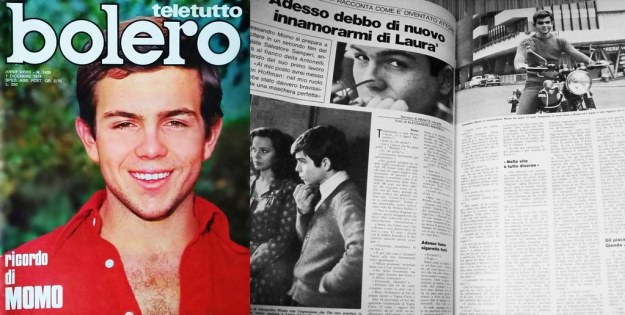
Almost forgotten in Italy. Completely forgotten by the rest of the world.
There was once a time when Alessandro Momo looked destined to take on the world.
But life dealt him a fatal blow.
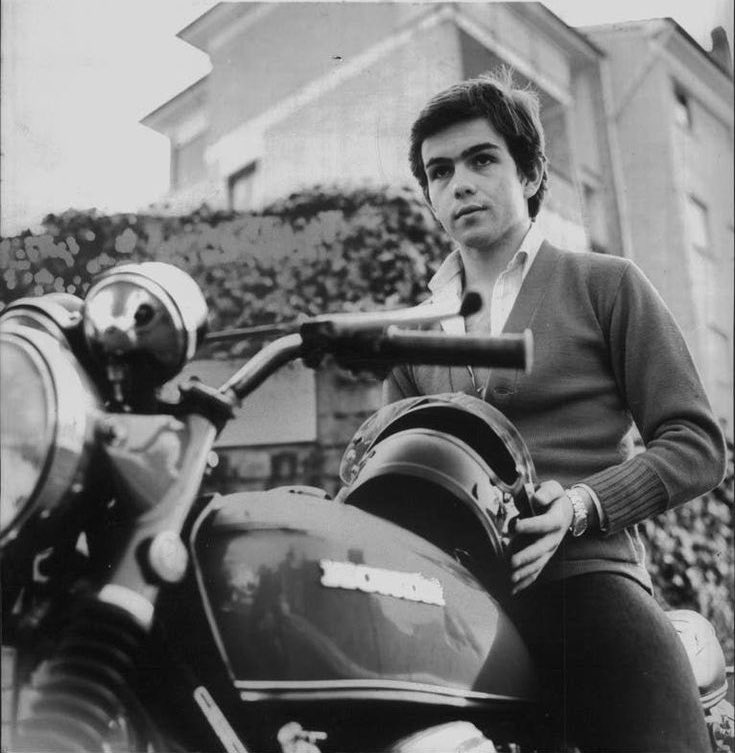
On November 19, 1974, the 17-year-old actor was speeding along Lungotevere Maresciallo Cadorna, a prominent and scenic stretch of boulevard running alongside the Tiber in Rome’s Della Vittoria quarter, on a borrowed Honda CB850 motorcycle.
“I’m lucky. The police won’t catch me.”
When a taxi turned left into Via Roberto Morra di Lavriano, Momo swerved, hit the taxi and was thrown more than ten metres into the opposite lane, his torso crushed against the motorcycle’s handlebars and fuel tank.
He was taken to Ospedale di Santo Spirito in Sassia with horrific injuries: a fractured fifth rib, subcutaneous emphysema of the left hemithorax, a left orbital haematoma, abrasions to the right parietal bone, bruising to his lips and nose, a contusion to the left hypochondrium, extensive contusions and abrasions to his limbs, a ruptured spleen and a lacerated stomach.
He underwent emergency surgery but died ten hours later.
There was something eerily reminiscent of James Dean in his death.
Like Dean and his fast cars, Momo regarded motorcycles as his great passion. And, like Dean, he died doing the thing he loved, at precisely the moment when his career seemed ready to take off.
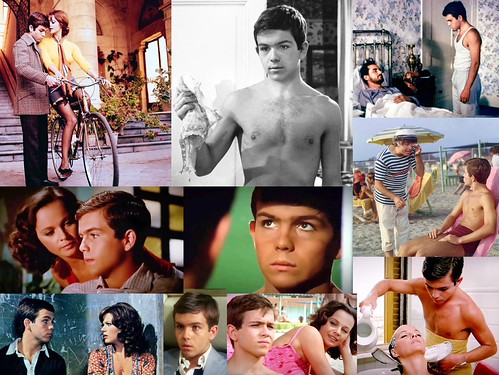
The strikingly youthful, dark-haired adolescent, with his intense blue eyes, embodied the quintessential look of the brooding and magnetic 1970s Italian teenager.
He projected a mixture of innocent charm and rebellious energy that defined his breakout performances in films such as Malizia (1973) and Profumo di donna (1974).
In Malizia, Momo played an intense, observant and brooding 14-year-old boy navigating his sexual awakening.
“The sexual curiosity of Momo is perverted and sadistic,” wrote one critic.
But there was something about Momo that captured the joys, anxieties and awkwardness of sexual awakening for a generation of young Italians.
At the time of his death, he had just completed Profumo di donna, in which he played a naive young military cadet nicknamed “Ciccio” — “Babyfat” — who is assigned to serve as the personal aide to a blind, retired army captain.
Its English title was Scent of a Woman. The film received two Oscar nominations and would later become the direct inspiration and source material for the 1992 American remake starring Al Pacino and Chris O’Donnell.
Before this, Momo had appeared in several films and, reportedly, never acted with his own voice. In both Malizia and Profumo di donna, he was dubbed by Sandro Acerbo, who would go on to make a successful career as a voice actor.
Newspapers initially reported that Momo was 19 when he died.
The error was significant.
It was subsequently discovered that he was only 17, just one week short of his eighteenth birthday, and therefore not legally entitled to ride a motorcycle.
The Honda had been lent to him by his romantic partner, the 21-year-old actress Eleonora Giorgi. She was investigated over the circumstances of the accident but was never indicted, having reportedly been told by Momo that he was 21. His family confirmed that he had repeatedly lied about his age.
Years later, Giorgi said that the immense guilt and psychological trauma following his death triggered a downward spiral into heroin addiction.
“With him, we were two solitary beings. This was our understanding. We were drifting, like a raft, but with a nuclear engine. Extremely strong, healthy, famous and scary young. Enviably beautiful. Together, even more so, because we multiplied our energy tenfold.”
And then, almost in an instant, it was over.
Alessandro Momo had been given the face, the talent and the moment. What he never got was the future. At seventeen, with Malizia behind him and Profumo di donna still waiting to be seen, he disappeared just as the world was beginning to notice him. Perhaps that is why his death feels so strangely unfinished: not simply because a young man died, but because somewhere beyond that November night in Rome was a life we will never know — all the films he might have made, the man he might have become, and the career that never had the chance to begin.