Extracts from Despised and Rejected by A.T. Fitzroy (Rose Allatini) (1918)
“Dennis thought again, with an odd pang of tenderness, how absurdly young he looked, and how his mother must love to stroke back the dark hair from his forehead. There was a photograph of her on the mantelpiece – a tired-looking woman with dull eyes and long slender hands. The father, from his portrait, was evidently thick-set, with side-whiskers and a self-assertive expression. A queer couple, they seemed, to have bred this finely-strung creature with the tanned face, sensitive level brows, and great black eyes that burned with a smouldering fire.”
“Dennis added in a lower voice, ‘I shouldn’t find one like you. I shouldn’t find anything half as good.’
Alan glanced up with a quick flush of pleasure. ‘You’ve liked meeting me, then… Ah, but you can’t have liked it half as much as I’ve liked meeting you. Think of it – after all this time and among these people, suddenly to come across another human being from the world I’ve almost forgotten!’
Dennis said half-aloud: ‘Consider the even greatest wonder of meeting someone from a world that one didn’t know really existed – that one had scarcely dared to dream into existence.’
Alan cried eagerly: ‘Then you’ll stop on here for a bit, won’t you? Give a poor starving wretch a chance!’
“It would be cruel to refuse Alan’s request. In spite of the magnitude of the task which the boy had set himself, and although he was engrossed in it heart and soul, he was still young enough to want his play-time, genuine play-time; not the play-time of which, he had told Dennis…. He was asking for play-time now, but Dennis knew that he must not yield; must tear himself away from a danger doubly dangerous, because, far from wishing to avoid it, he longed to succumb to it!”
***
These striking lines were considered daring in 1918 and, perhaps inevitably, Despised and Rejected was banned. Not, however, for the excerpts above, but for other seemingly innocuous lines:
“Isn’t this worth fighting for?” Dennis smiled as he answered the question: “It’s worth more than that; it’s worth – not fighting for!”
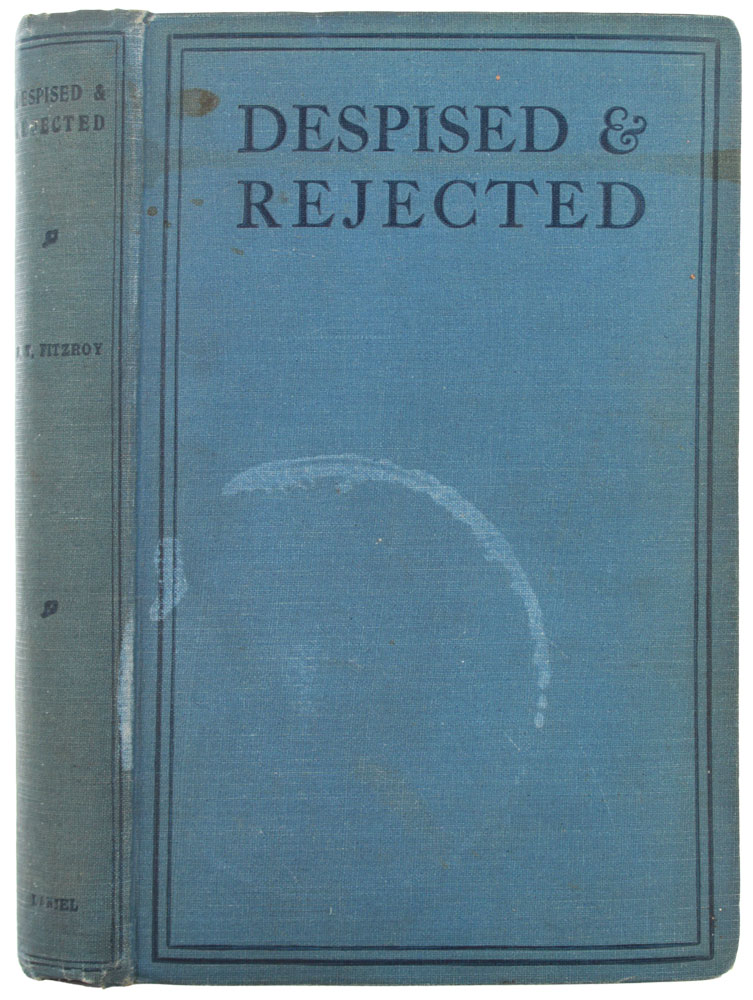
Despised and Rejected was published in May 1918, while Britain was still at war with Germany. It was first submitted to George Allen & Unwin, but Stanley Unwin rejected it on the grounds that the firm might be liable to prosecution. He instead suggested offering the novel to C.W. Daniel Ltd, which agreed to publish it.
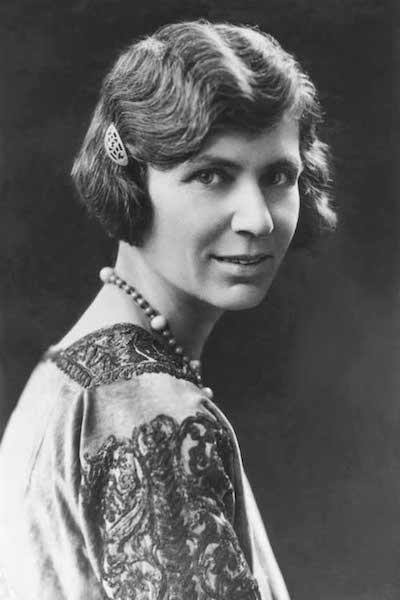
The book was written under the pseudonym A.T. Fitzroy, the nom de plume of Rose Allatini, whose first novel had been published by Mills & Boon in 1914. She was born in Vienna in 1890 to a Polish mother and an Italian father, but was raised in England.
The publisher’s publicity offered a revealing indication of the novel’s themes:
“A vigorous and original story, dealing in an illuminating way the two classes of people who are very commonly misunderstood – the Conscientious Objectors who refuse military service, and the so-called Uranians whose domestic attachments are more in the way of friendship than of ordinary marriages.”
When reviews appeared, critics focused less on the anti-war message and more on what they perceived as the novel’s treatment of homosexuality:
“The treatment of sexual matters is strictly decorous and there is nothing to attract the reader in search of sensationalist fiction, which is just as well, for the author’s standpoint is pitifully repellant.”
This, however, was mild compared to what followed:
“It is a beastly book, full of unnatural vice, and not written in the admirable literary style which gave a glamour to a certain book by Oscar Wilde.”
And,
“If the author wished to enlist our sympathy for those who are congenitally, sexually perverted, it could be wished that she had asked our pity and not for our admiration, and did not consider such persons as necessary for the production of the higher type, that which the whole considers to be wrong is not therefore proved to be right.”
And,
“A thoroughly poisonous book, every copy which ought to be put on the fire forthwith.”
In September 1918, Charles William Daniel, the publisher of Despised and Rejected, appeared before Sir Charles Wakefield at the Mansion House. He had been summoned at the insistence of the Director of Public Prosecutions for making unlawful statements likely to prejudice recruitment, as well as the training and discipline of those serving in His Majesty’s Forces, contrary to Regulation 27 of the Defence of the Realm Regulations.
Notably, the homosexual content did not appear to be the central issue; rather, it was the novel’s anti-war message that provoked concern.
Daniel pleaded not guilty, and the case was adjourned to allow Sir Charles to read the book for himself. When proceedings resumed in October, Sir Charles stated that the question of obscenity was not before him, though he did not hesitate to describe the work as “morally unhealthy and most pernicious.”
Penalties totalling £460 were imposed on Daniel, with the threat of imprisonment should he default on payment. In all, 1,012 copies of Despised and Rejected had been printed, of which 667 had been sold; the remainder were confiscated.
The Herald, which had previously shown sympathy toward Oscar Wilde, launched an appeal to cover the fine. It was oversubscribed, and among the contributors was Stanley Unwin—who had originally rejected the manuscript.
After this, Despised and Rejected fell into obscurity until it was republished by Gay Men’s Press in 1988.
Today, a first edition can command prices in excess of £1,000, and even later editions are often costly. However, modern readers can obtain a more affordable paperback edition, now republished under Rose Allatini’s own name.
In her personal life, Rose Allatini married the composer Cyril Scott in 1921, and the couple had two children. They separated in 1939, after which she lived with fellow writer Melanie Mills—an arrangement that has prompted comparisons with the character of Antoinette in Despised and Rejected.
Over the course of her career, Allatini published around 40 novels under several names, including A.T. Fitzroy, Mrs Cyril Scott, and Lucian Wainwright, though the majority—around 30—appeared under the pseudonym Eunice Buckley. She died in 1980.