
Part 2
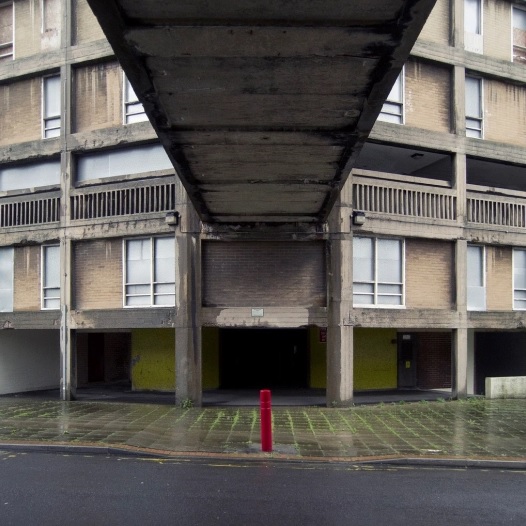
Tonight, I walked up the old-cobbled street from Sheffield Station. It passed over the railway line and was probably once lined with slum terrace houses. They vanished long before I was born. In my lifetime, this lost street has always fallen under the shadow of Park Hill.
It was dark and raining and the new streetlights made the wet stones sparkle. I saw three lads balancing on the old white railings at the top. They watched me approach. I slipped a hand in my pocket and felt for the tactical torch.
“Wrap the strap around your wrist, grab the torch like a dagger, and hit them on the side of the head with the jagged edge, remembering to twist it at the same time.”
I remembered these words from the man who gave it to me in London. It was after I’d been robbed of my phone in Bethnal Green. That was four years ago, still handy with my fists, but no match for the knife that stuck in my arm.
Park Hill might have become trendy, but some things never changed.
The lads said nothing, and I knew that silence could be dangerous. Three minds, three trains of thought, three different outcomes. I knew from experience.
I considered the time forty years ago when I’d sat in the same spot with Andy and Jack. Teenagers. Geisha Boys. Hard boys from the flats.
The lad had walked up this same street. We recognised him from Hyde Park, and he was walking into our territory. We stared him out, but this lad turned out to be more stupid than brave.
“What’s tha looking at bum boys?” he’d said.
We didn’t reply.
Andy was the first. He’d punched him in the face, blood splattering down the lad’s parka coat. Jack had kicked him in the stomach, and the lad fell to the floor. I reached for a half house brick and smashed it down on the back of his head.
There it was. Three minds, three trains of thought, three different outcomes.
All these years later, I thought that karma came around.
These three lads were different. One was White, one was Black, the other was Asian. Teenagers.
I recalled the words of the man who gave me the tactical torch.
“Be warned. You might end up killing somebody!”
“Have you got a smoke?” I think I took them by surprise.
The White lad produced a cigarette from nowhere and the Black lad gave me a cheap purple lighter. I lit it and took a drag.
“Thanks guys. I appreciate it.”
The Asian lad nodded. The White lad looked at the floor. “It’s ok bro’,” said the Black lad.
I smoked the cigarette as I walked towards the apartments. I didn’t look back until I reached the communal door. The three lads were still there, deep in conversation, and no threat to me.
What if that Hyde Park lad had done the same? Might things have been different? He had been called Brian and two years after we beat him up, he fell from the tenth floor of Hyde Park flats.
I have been back in Sheffield a month now and have yet to start writing my fourth novel. But tonight, I thought about these three young lads, and they reminded me of the Geisha Boys. And I thought about all the memories that have resurfaced these past weeks, and I accepted that Megan, my agent, might be right.
I sat down at my laptop and wrote the following words: –
“I was making a coffee at the time, staring out of the window, looking at a world that used to be marvellously different.”
*****
I was born in the sixties, and I didn’t know anything about Park Hill. It was years later, when writing an article for The Guardian, that I learned about the place I grew up.
It was allegedly based on Le Corbusier’s Unité d’Habitation In Marseilles but this was too bizarre for us to understand.
I was born in 1966, the last time England won the World Cup, and Sheffield Wednesday lost a cup final to Everton. Park Hill was home. It was the only place I knew. We lived in the sky and looked down at the rest of the world. And for all I can remember, my first five years were spent within four walls and on a balcony as wide as a street. My earliest memory is the milk cart, as big as a car, that delivered every morning.

My family were called Oldham. It was an unusual surname, but my dad liked it because every Christian name went well with it. He was Peter Oldham, my mum was Pat Oldham, I was called Harry Oldham, and my younger brother became Adam Oldham. And there were lots of cousins across Sheffield.
Mum and dad moved to Park Hill in 1962 when it was still new. They were rehoused after their old back-to-back house at Netherthorpe was bulldozed. He was a cutlery worker, she was a wages clerk, and they were relatively poor.
But Park Hill promised clean and modern surroundings in which to raise a decent family. That dream eventually died, and the respectability of the Oldham family was often placed in doubt by Harry Oldham… me.
I hated my name. Harry was the name for an old man. When I was growing up there was nobody called Harry. But life goes full circle and at last, at the age of 56, I have a fashionable name and happy to be Harry.
Before lockdown, I was invited to see a play at the Crucible Theatre called Standing at the Sky’s Edge. I visited Sheffield with my partner, Scott, who had never been before. The account began in 1961 and told the story of three families over sixty years living in Park Hill. Scott loved it, but I came away feeling sad because it aroused memories of a life I thought was behind me. It might have been written about my family, my friends, and me.
I went back to London and wrote a third novel, and when that flopped, I realised that I wasn’t clever enough to be a crime writer.
Now I am back here. At Park Hill. I am writing another novel, one where I will not have to do any research and spend weeks scripting the storyline. The plot is already in my head. It has already happened. The story is real.
Yet, as I write, I realise that it is not so much a novel but is a collection of reminiscences.
 Perfectly Hard and Glamorous