Tag Archives: dreams

Last night I dreamt I was eighteen again

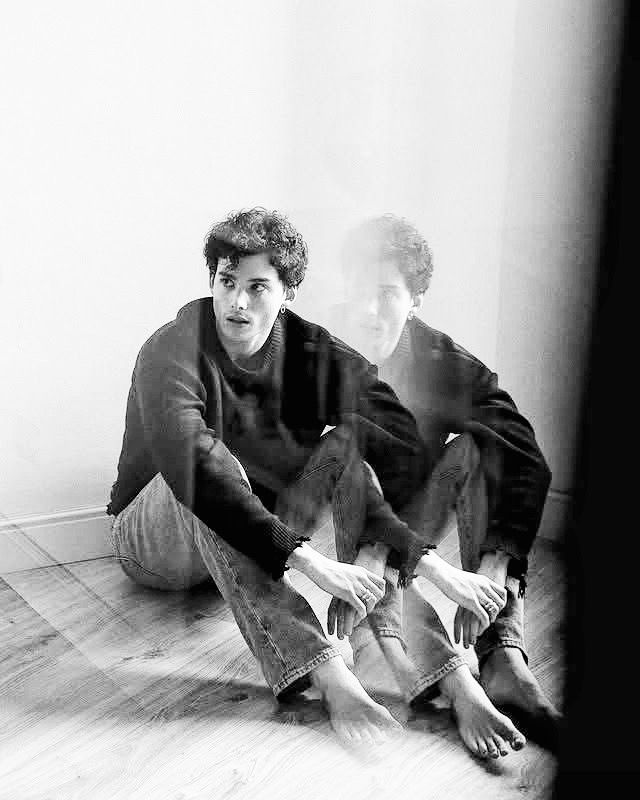
The Boys- Charlie Marseille (2026)

Hormonal Surge: Increased testosterone, fuelling restlessness and the need to discharge energy, sometimes through risky or boisterous play, mock fighting, and testing boundaries.

I wake and can hear music playing in the other room. It is an eighties song – Calling All the Heroes – and it is perfect. My first waking moments are defined by a song made before I was born. It will become a favourite. Whenever I hear it, I will recall the dream.

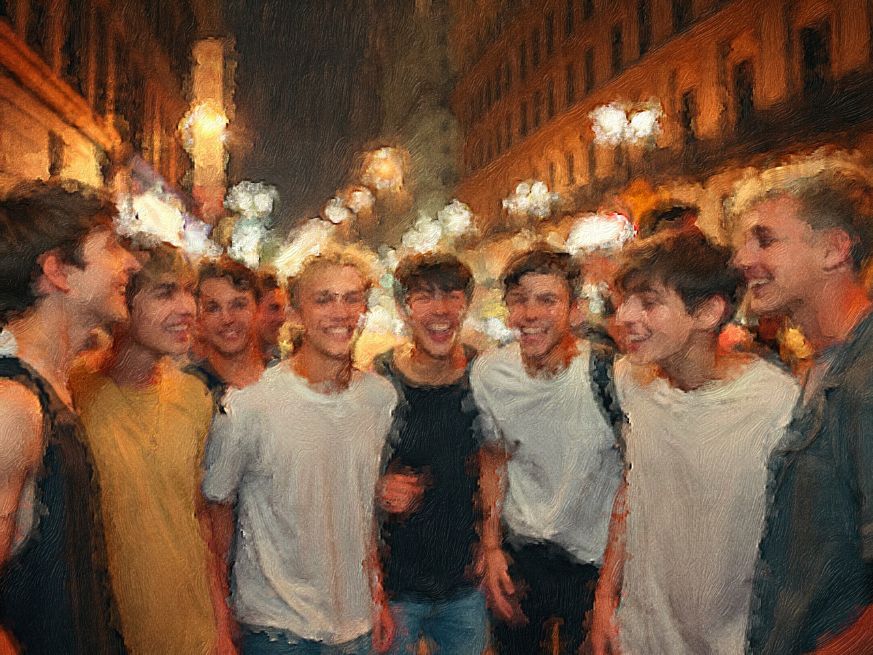
I’m eighteen. Like I always am. There are twenty boys of a similar age. We don’t know each other, but we have bonded; something connects us, though I don’t know what it is. And now we are friends. Brothers who drink too much, laugh, and joke. We move from bar to bar until the group becomes fragmented, but still we keep bumping into one another — in different bars, on street corners, in dark streets – and each time we greet each other with high fives. I keep losing my coat that contains my mobile phone, but somebody in the group always finds it and saves it for me.”

What am I dreaming about?

Eighteen. Delayed or suspended adolescence. The moment just before categorisation -before ‘out’ or ‘not out’, before relationships are legible, before desire is policed or explained. A moment of pure potential, when attraction, friendship, and self-recognition have not yet been sorted into boxes. A group of boys I don’t know, where intimacy doesn’t have to announce itself as erotic to be real. Touch exists: high fives, a coded language, bodies moving together through night-time space, alcohol loosening edges, and the bond is felt rather than named.

These boys don’t posture. They don’t test me. They don’t ask who I was. They simply accept me. A world that perhaps never fully existed, but felt briefly possible.

The group breaks apart, but there is no need to cling because the bond reasserts itself naturally. “I still know you. You still know me.” I repeatedly lose my coat and my phone – yet I am never punished. I am held by others even when I am careless, distracted, or drifting. I don’t have to hold myself together perfectly. I’m not abandoned for losing my way. A fantasy of uncomplicated male belonging – one where youth, desire, friendship, and identity coexist without fracture or explanation.

The next part of the dream is important.

“There are ten of us staying in a hotel room. It is the only one available. We snack on almonds and slices of apple covered in salted caramel and maple sugar. Two double beds and a single mattress on the floor. When it comes to sleep, we must find space in one of the beds. I choose a double bed where four of us will squeeze together. I’m thrilled that the most handsome boy will sleep next to me. But at the last moment, he is taken. Another boy wants him to share the mattress on the floor, and I am devastated. The dream is never consummated.”

The hotel room matters. It is temporary, improvised, and not designed for this many bodies. I share a bed with four boys. The choice is telling. I don’t choose privacy, pairing, or exclusivity. I choose crowded intimacy – warmth, bodies, breath, limbs overlapping. Proximity without the exposure of being singled out. I am about to be close to the handsome boy without declaring him an object of desire, but he isn’t a person yet – he is a figure onto which desire might safely attach itself. 

The handsome boy doesn’t reject me; he is summoned – pulled away by another boy. Desire is displaced, not denied. My devastation isn’t only about losing him. It is about losing the fantasy of being quietly chosen within the group. But the group has ruptured because somebody else’s desire has rearranged the night. My loss is intimate, quiet, internal – no one else even notices it happening – and so I do not follow. I do not compete. I do not protest. I absorb the loss silently. 

I woke up.

Charlie: Almost. Almost. The Scent That Remained

Un amante italiano – Charlie Marseilles

Charlie didn’t go to Paris for Christmas. A family dispute—best addressed through absence—kept him away. Instead, he stayed with a cousin in Woodstock, near Blenheim Palace: an improbable place for pleasure. I was content with the opposite arrangement. Christmas alone. Eating, drinking, letting Netflix decide what mattered.

On Christmas Eve, I dreamed he climbed into bed and lay on top of me. His naked body was warm, yielding, unmistakably real. He kissed me. A faint musk rose from his skin—intimate, animal—stirring every sense at once. At last, I thought, this is the closeness.

I woke up with the sensation intact. The dream clung to me through Christmas morning, vivid enough to unsettle. I searched for an explanation and learned that smell can infiltrate dreams, especially when memory and desire are involved. Olfactory dreaming, they called it. Cologne was the usual example.

In the nineteenth century, a French physician, Alfred Maury, described inducing such dreams by getting his assistant to place eau de Cologne beneath his nose while he slept. On waking, Maury claimed to have dreamt of Cairo, of the perfumer Farina’s workshop, of adventures set loose by scent alone.

I hadn’t smelt Cologne. What lingered with me was the smell of a boy. And with it, a quieter truth: Charlie and I had never moved beyond kissing.

Someone, inevitably, had to puncture the theory. A psychiatrist dismissed the idea entirely. You don’t smell the coffee and wake up, she insisted. You wake up, then you smell the coffee.

I abandoned science and let Spotify take over. It suggested an album by Wolfgang Tillmans, which surprised me. I’d known him only as a photographer. The music turned out to be a sound work made for an exhibition—joy and heartbreak threading through collapse and repair.

I first encountered Tillmans years earlier through a Pet Shop Boys video composed almost entirely of mice living on the London Underground. Ever since, I’d found myself scanning platforms, tunnels, tracks—without success. A memory surfaced: my friend Stephen once worked on a four-hour Tillmans sound installation of It’s a Sin. He now despises the song completely.

Christmas dinner was an indulgence of sorts: cold baked beans eaten straight from the tin. I spent an hour scrolling through films before accepting, once again, that choosing outlasts watching. I downloaded the Christopher Isherwood biography David had recommended—the one that never seems to end—and fell asleep within pages.

When I woke, the room had darkened. Charlie had messaged: Will be home tonight at about eight x.

Transport on Christmas Day was nonexistent, yet somehow he’d convinced his cousin to drive him 130 miles. When Charlie arrived, I asked where his cousin was.

“Gone back,” he said.

“You didn’t invite him in?”

“It’s Christmas. He’ll want to be home.”

“And petrol money?”

He hesitated. “I didn’t think of that.”

Our former lodger once called Charlie a “me, me, me person.” Another friend was less generous and called him an asshole. Perhaps it was cultural. Perhaps it was simply him. Charlie struggled to imagine himself from the outside. I told myself it wasn’t malice. Just a narrow field of vision.

Despite the journey, he looked fresh, handsome. He smiled; I mirrored it. I considered mentioning the dream, then decided against it.

“Why come back early?”

“I shouldn’t have left you alone,” he said, without pause. “It’s Christmas.”

While he dropped his bag in the bedroom, I switched on the tree lights. We exchanged gifts a day early.

His were faultlessly chosen: Salò on Blu-ray, Sargent, Ramón Novarro, Edmund White, a glossy Igor Mattio photography book. Then he disappeared into the studio and returned with a canvas. He turned it around.

It was me.

He’d painted me sitting, relaxed, looking beyond the frame—as if caught somewhere warmer, lighter. My eyes were generous. My mouth was kind. Around my neck he’d included a thin silver chain, a birthday gift I wore only on rare occasions. The detail felt deliberate, almost intimate.

“I painted while you were writing,” he said. “I hope you like it.”

I had never been seen like that before. Not by anyone. I felt exposed, and cherished.

“I don’t know what to say,” I told him.

“One day,” he said lightly, “when you’re old—célèbre—people will say, painted by his French lover.’”

Charlie went to shower. Alone, I recognised a flicker of shame. I’d suspected his absence was a ruse. I’d rehearsed disappointment, punished him silently for not being who I wanted. The dream—so tender, so convincing—had fed that instinct. Sex can exist without love; love can exist without sex. The phrase circled uselessly.

Still, it would be nice.

There it was again. That reflex. The mind’s preference for negativity over positivity. 

Charlie returned wearing only grey jogging bottoms and a Santa hat. He stretched out beside me on the sofa, smelling faintly of crushed mandarins, and rested his head in my lap.

“A Christmas film,” he murmured. “Something cosy.”

I stroked his stomach as we watched The Holdovers: a misaligned teacher, a sharp-tongued cook, a boy full of grievance. By the end credits, Charlie was asleep.

I didn’t move. I was afraid that motion would undo everything. His weight, his warmth, the faint citrus on his skin—it felt provisional, like something borrowed. The room held its breath.

I loved him then with a sudden, almost painful tenderness. Not the urge to claim, but to preserve. To keep the moment intact, untouched by language or expectation.

I stayed exactly where I was.

And waited to see whether stillness could last.

That Dream / I Luv Ya, Will Ya Marry Me?


I dined on slivers of Parmigiano Reggiano and a Banana Ice vape; the combination could be the meal of the damned. Later, I dreamt that Yungblud was dancing in front of me and singing ‘I luv ya, will ya marry me?’ Afterwards he sat cross-legged on my sofa wearing grubby boxers and white socks and nibbled on a pork pie. I told Charlie about my dream. “Not that little twerp from Doncaster,” he said in his French accent.

I told him I had a strange dream last night, and he said, “I know, I was there”

Image: Riccardo de Rinaldis Santorelli

Who were you in my dream last night? We wandered barefoot through empty streets and drank in dirty bars. It was a good feeling, and we said we’d do it again. Yet, when I awakened, I wasn’t sure who you were. I thought I knew you but didn’t know where from. Were you a missed opportunity, who’d come to remind me that you might once have existed? So many questions. Be calm, be tender, and maybe I’ll love, I decided.

That Dream / It’s good to see you again, but I also have something to tell you

Image: Archer Iñíguez

That was a bloody good dream I had that night. 

I walked into a room and found Sam Roberts smiling like he always did. I expected him to disappear, but he didn’t, and he gave me a big hug. 

“What are you doing here?” 

“I’m always here, but you never see me,” he chuckled.

“I’ve not seen you for nearly 40 years.”

“Well, this week you’ve been thinking about me, and that’s a good reason to see you.”  

I didn’t know what to say. 

“But I also have something to tell you,” he added. “I want you to know that we never go away, and that means that you should never be sad.”

“Grandad, I’m not sad. In fact, I’m incredibly happy to see you.”

He was about to say something else but thought better of it. I could see that his figure was quickly fading, and there was only enough time for him to smile and wave, and in a flash, he had vanished.

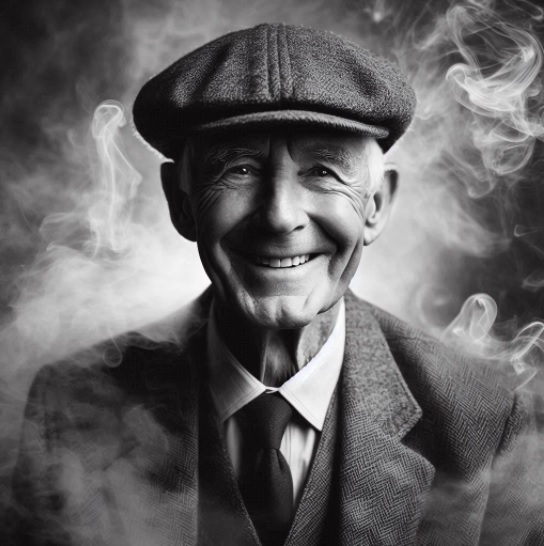
Today, I thought about that dream after I received the telephone call to say that my dad had passed away.